Spa Control Board: 5 Critical Signs It Has Failed

The spa control board is the main circuit board inside your spa pack — it handles relay switching, temperature control logic, pump timing, and safety input processing. When it fails, the spa may go completely dead, show persistent error codes, or have components stuck on or off. The most important rule: rule out every individual component (sensor, pressure switch, high limit switch, heater element) before concluding the control board itself has failed. Board replacement is the last step in the diagnostic sequence, not the first.
How a Spa Control Board Works
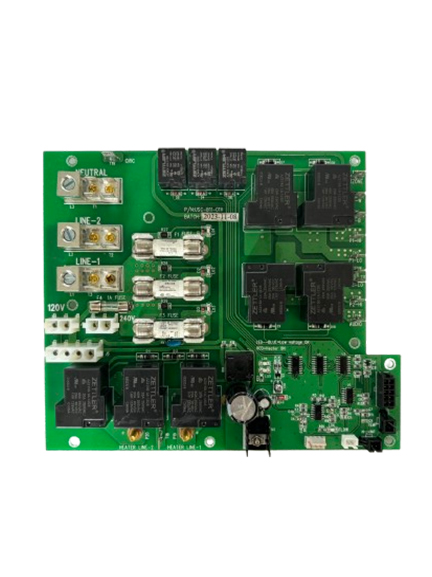
The spa control board is the central processing unit of the spa’s electrical system. Every action the spa takes — heating the water, running the pump, displaying temperature, responding to button presses on the topside panel — is coordinated through the spa control board. It receives input signals from sensors and safety switches, processes those signals against programmed logic, and switches output relays to control the heater element, pump motor, and any lights or accessories in the system.
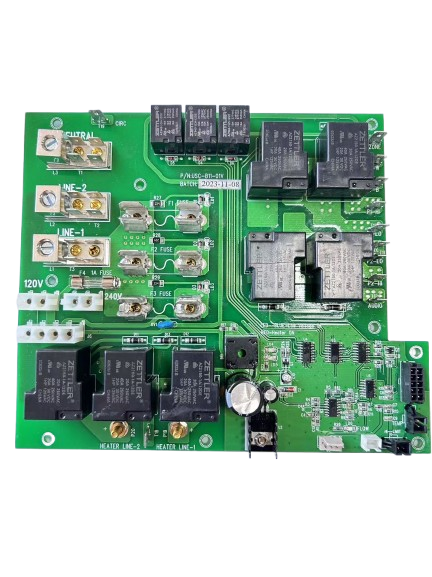
Physically, the spa control board is a PCB (printed circuit board) mounted inside the spa pack enclosure. It has two functional zones: a high-voltage section where the output relays switch 240V power to the heater and pump, and a low-voltage control section that runs on reduced voltage internally and handles all the signal processing and decision logic. The two sections are electrically isolated from each other on the board, but both must function correctly for the spa to operate normally.
The board receives signals from four main sources: the temperature sensor (water temperature measurement), the pressure switch (flow confirmation), the high limit switch (emergency thermal cutoff), and the topside panel (user inputs). If any of these input signals is outside the expected range, the board takes a protective action — typically shutting down the heater, displaying an error code, or both. This is why component faults so frequently look like board faults: the board is functioning correctly, but it is responding appropriately to a bad signal from a failed external component.
Understanding this input-output relationship is fundamental to correct diagnosis. A spa that shows a pressure switch fault code is not necessarily experiencing a spa control board failure — the board may be correctly reading a genuinely failed pressure switch. The error code is information about what the board sees; it is not always a verdict about the board’s own health. Only after all input signals have been verified as correct should the board itself be suspected as the fault source.
5 Critical Signs the Spa Control Board Has Failed
Sign 1: The Spa Is Completely Dead — No Display, No Relays, No Response
A spa control board that has failed completely presents as a system that appears powered (the GFCI breaker is on, voltage is present at the pack terminals) but shows no signs of life: the topside display is blank, no relays click, and pressing topside buttons produces no response. This is the clearest indicator of a board-level failure, particularly when it follows a known power event such as a lightning storm or utility outage.
Before concluding the board has failed, verify with a multimeter that 240V is actually reaching the board’s input terminals inside the enclosure. A tripped GFCI or a blown fuse in the equipment circuit can produce the same dead-system presentation without the board being at fault. If voltage is present at the board inputs and absent at all outputs, the board is the failed component. For power circuit verification, see our spa control box wiring guide.
Sign 2: Error Codes That Cannot Be Cleared After Component Verification
Error codes that persist after the relevant component has been tested, verified, and found to be in good working order indicate that the spa control board is generating a false fault reading. For example, a persistent FLO error after the pressure switch has been tested and confirmed closed at normal operating flow points to a board-level fault in the pressure switch input circuit. A persistent SN (sensor) error after the temperature sensor has been replaced and confirmed at the correct resistance points to a failure in the board’s analog-to-digital conversion circuit for that input.
The key diagnostic rule is that error codes should be cleared by fixing the underlying condition. An error code that doesn’t clear after the component it references has been replaced or verified is a strong indicator that the board’s input circuit — rather than the external component — is reading incorrectly. Our spa control system error codes guide covers the mapping between error codes and their root causes.
Sign 3: A Component Runs Continuously Without Shutting Off
A heater that runs past the set temperature without shutting off, or a pump that runs 24 hours a day without entering a rest cycle, indicates a relay on the spa control board that is stuck in the closed (energized) position. The relay contacts have fused together — a failure mode caused by electrical arcing over time or by a surge event that overloaded the relay coil. Once a relay is stuck closed, the board’s control logic cannot open it regardless of what temperature or timer signals it receives.
A heater relay stuck closed is the more dangerous scenario, as it can cause water temperature to climb past the target temperature and eventually trip the high limit switch as backup protection. If the high limit switch also fails to trip, the water can reach temperatures that pose a thermal risk to bathers. If your spa is heating continuously and the temperature is climbing past 104°F, shut off the GFCI breaker immediately and do not use the spa until the fault is diagnosed. See our spa thermostat guide to rule out a temperature sensor fault before concluding the relay is at fault.
Sign 4: Intermittent Operation That Gets Progressively Worse
A spa control board that is developing a failure often presents with intermittent behavior weeks or months before complete failure. Common intermittent symptoms include: the topside display flickering or going blank briefly, relays clicking at unexpected times, the spa restarting spontaneously, or error codes appearing and clearing without user intervention. These symptoms are easy to dismiss as software glitches, but they are usually the first signs of physical board degradation.
Intermittent failures are most often caused by one of three mechanisms: a cold solder joint that is making and breaking contact as the board thermally cycles, a capacitor that is failing and producing erratic voltage levels in the control circuit, or a connector that has developed high contact resistance from corrosion. All three failure modes worsen over time. A board that is intermittent today will typically fail completely within weeks to months. Addressing it while the symptom is intermittent avoids the more disruptive complete-failure scenario. Our United Spa Controls B11 guide covers the replacement procedure for the board in B-series systems.
Sign 5: The Topside Panel Shows Random Characters or Is Unresponsive
Communication between the spa control board and the topside panel runs over a serial data connection through the topside cable. When the board’s communication circuit fails, the topside panel may display random characters, freeze on a single screen, or become completely unresponsive to button presses. The pump and heater relays may still function (if the relay section of the board is still intact), but the user interface is lost.
Before concluding the board’s communication circuit has failed, substitute the topside cable with a known-good cable or inspect the cable connector at both ends for corrosion. A corroded topside cable connector is far more common than a board communication circuit failure and produces identical symptoms. Our spa topside cable guide covers connector inspection and cleaning. If a known-good cable does not restore the display, the board’s communication circuit has failed and the board requires replacement.
How to Diagnose a Spa Control Board Fault
The correct diagnostic sequence for a suspected spa control board fault follows a strict component-first order. Skipping steps or jumping to board replacement without completing the component checks is the most common and most expensive mistake in spa repair. Follow this sequence in order:
Step 1: Verify power supply. Confirm that 240V is reaching the spa pack terminals with a multimeter. Verify the GFCI breaker is not tripped and that both legs of the 240V circuit are live. A single-leg failure (120V instead of 240V) is often caused by a tripped breaker on one leg of a double-pole breaker and can produce a dead or erratically functioning system without the board having failed at all.
Step 2: Check the high limit switch. Locate the manual reset button on the high limit switch (typically on the heater manifold) and press it firmly. A tripped high limit switch prevents the heater from running and can cause the system to behave as if the board has failed. If pressing the reset restores normal operation, the root cause is a thermal event — address the flow or filtration issue rather than replacing the board. See our high limit switch guide.
Step 3: Test the pressure switch. With the pump running, verify that the pressure switch is closed (conducting). An open-circuit pressure switch blocks the heater relay from closing and generates a FLO or similar error. Testing the switch with a multimeter or briefly jumping the switch terminals (for diagnostic purposes only — never leave it jumped permanently) confirms whether the flow circuit is the fault source. See our pressure switch guide.
Step 4: Test the temperature sensor. Measure sensor resistance at the board connector terminals. A healthy NTC sensor should read approximately 9,000–11,000 ohms at room temperature. OL (open) or 0 (short) indicates a failed sensor. See our spa thermostat guide for the full testing procedure including temperature correlation.
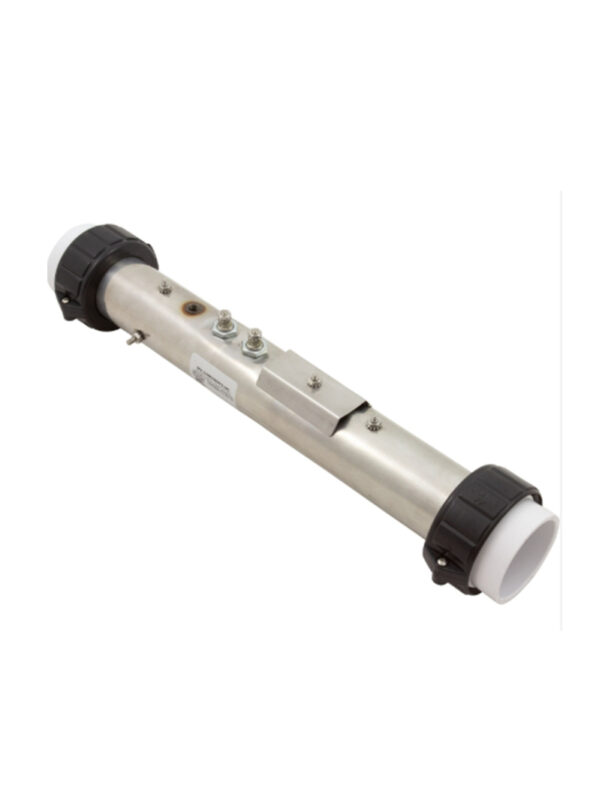
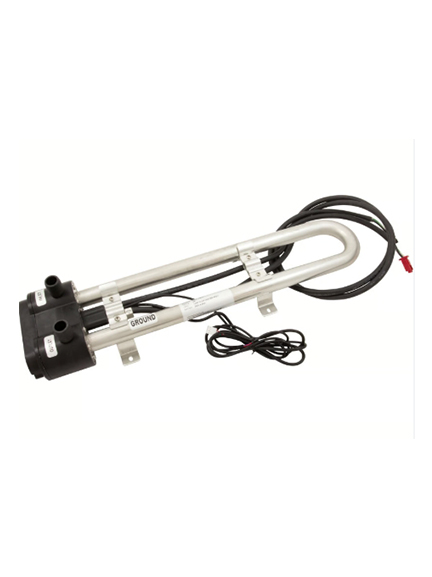
Step 5: Test the heater element. With the system powered down, measure heater element resistance across the element terminals. A healthy 4 kW / 240V element should read approximately 14 ohms. OL indicates an open-circuit element failure. A shorted element will also cause persistent GFCI trips. See our spa heater element guide for the full test including insulation resistance.
Step 6: If all components pass — replace the spa control board. Only after all five external components have been confirmed in good working order should the board itself be condemned and replaced. At this point, the board is the remaining unverified variable in the system. Follow electrical safety precautions and power down at the GFCI breaker before any board work.
Spa Control Board on United Spa Controls Systems
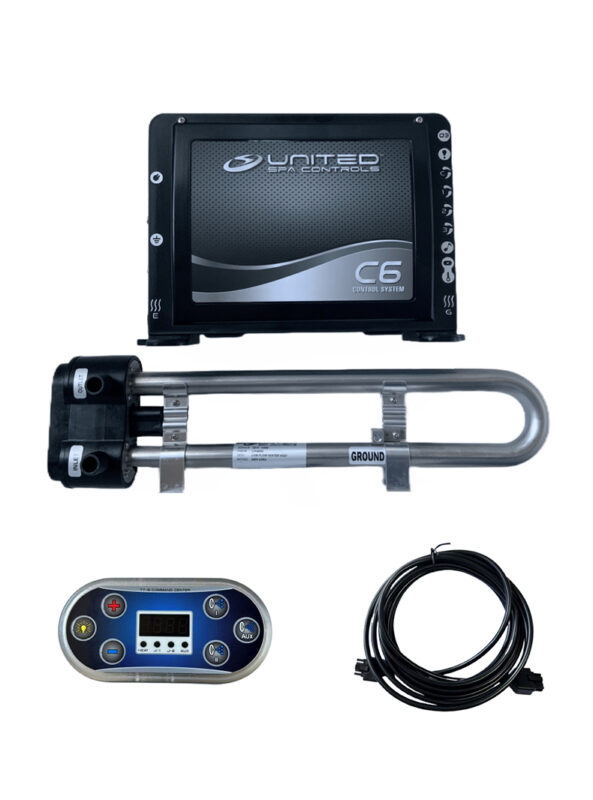
On United Spa Controls systems, the replacement spa control board designation depends on the system model. B-series systems (including the B Box) use the B11 power circuit board. CB117P and C6 systems use board generations specific to those platforms. The table below summarizes the relationship between system model and spa control board replacement.
| System | Board Replacement | Notes |
|---|---|---|
| B Box | B11 PCB | Verify revision by serial number |
| CB117P | CB117P board generation | Not interchangeable with B11 |
| C6 | C6-series board | Not interchangeable with B11 or CB117P board |
In all cases, the correct approach is to identify the control box model from the label on the enclosure before ordering a replacement spa control board. Boards are not cross-compatible between these three systems even though they share similar physical form factors. Our United Spa Controls B11 guide covers the B-series board in detail, and our CB117P guide and C6 guide cover the board considerations for those platforms.
Frequently Asked Questions
How do I know if my spa control board has failed or if it’s a component issue?
Follow the six-step diagnostic sequence in the How to Diagnose section above. Test the high limit switch, pressure switch, temperature sensor, and heater element in order. If all four components pass their individual tests and the symptom persists, the spa control board is the fault. Replacing the board before completing these checks often results in an unnecessary board replacement — components are the most common fault source.
Can a power surge damage a spa control board without tripping the GFCI?
Yes. GFCI breakers detect ground faults (current leaking to ground), not voltage spikes. A transient voltage surge can be brief enough to destroy the board’s control section components without creating a sustained ground fault current that would trip the GFCI. This is why a spa that was working before a storm and is completely dead after — with the GFCI not tripped — is a strong indicator of surge-damaged spa control board rather than a component fault.
Is it worth repairing a spa control board instead of replacing it?
Component-level repair of a spa control board (replacing individual capacitors, relays, or ICs) is technically possible but requires electronics repair expertise and is rarely cost-effective when a replacement board is available. The labor cost of component-level repair typically exceeds the replacement board cost. For United Spa Controls systems, the B11 replacement board for B-series systems is available directly from Spasrus. See our B11 guide for details.
Why does my spa control board keep failing?
Repeat spa control board failures almost always trace to either an unresolved surge exposure (install a surge protector on the 240V circuit) or moisture ingress into the enclosure (inspect and seal the cable gland, conduit entry, and enclosure door gasket). Replacing the board without addressing the root cause will result in another failure within months. See our B11 guide for guidance on moisture inspection before installing a replacement board.
What error codes indicate a spa control board failure specifically?
No error code reliably indicates a spa control board failure by itself — error codes reference the condition the board is detecting, not the board’s own health. A board-level fault is indicated when a component-specific error code persists after that component has been tested and confirmed good, or when the system shows no error code but is completely non-functional with power confirmed at the board input terminals. See our error codes guide for the complete code reference.
Should I replace the spa control board or the whole spa pack?
Replace only the spa control board if the heater element, pump, topside panel, and wiring harness are all confirmed in good condition. If the system is over 10 years old or multiple components have failed, a complete spa pack replacement is often more economical when you factor in the total labor cost of individual repairs. Our spa control box replacement guide and spa pack replacement guide cover the full-replacement decision.
Where to Buy a Replacement Spa Control Board
For United Spa Controls systems, replacement spa control boards are available directly from Spasrus. The correct board depends on your system model — B-series systems use the B11 PCB, while CB117P and C6 systems use their own board generations. Always verify the model and production date from your enclosure label before ordering to avoid a revision mismatch.
If you have completed the six-step diagnostic sequence above and confirmed that the spa control board is the failed component, ordering the correct replacement board from Spasrus is the fastest path to restoring system operation. Spasrus also carries complete control box systems if a full replacement is the more appropriate repair for your situation.
Related guides for complete spa control system diagnosis:
- United Spa Controls B11 — circuit board replacement guide
- Spa thermostat — temperature sensor testing
- Spa pressure switch — FLO error and flow diagnostics
- Spa high limit switch — HL error and thermal safety
- Spa heater element — testing and replacement
- Spa control box wiring — power verification
- Spa control system error codes
- Spa control box replacement — full guide
For the complete United Spa Controls product range, see the United Spa Controls systems page and the United Spa Controls brand overview.