Spa Thermostat: 5 Critical Signs It Has Failed

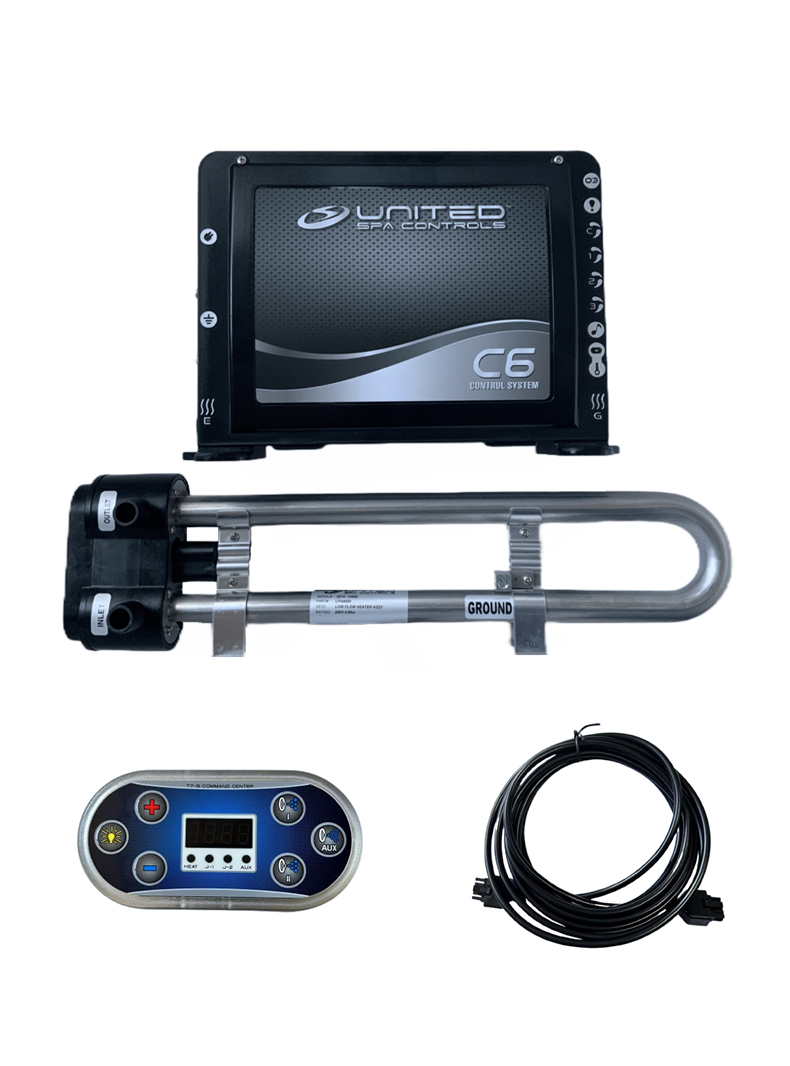
A spa thermostat is the temperature-sensing component that tells the control board when to run the heater and when to shut it off. On modern digital spa systems like United Spa Controls, the thermostat function is handled by a thermistor-based temperature sensor rather than a mechanical bimetal device. When the sensor fails, the spa either overheats, refuses to heat, or displays an incorrect water temperature. Testing takes under five minutes with a multimeter and a bucket of water.
How a Spa Thermostat Works
The term “spa thermostat” is used loosely by technicians and owners to describe the temperature-sensing and temperature-control function of a spa control system. On older mechanical systems, this was a bimetal disc or capillary-tube device that physically opened or closed a switch at a set temperature. On modern electronic spa packs — including all United Spa Controls systems — the thermostat function is split between two components: a thermistor-based temperature sensor that measures water temperature and sends a resistance signal to the control board, and the control board itself, which processes that signal and switches the heater relay on or off to maintain the target temperature set by the user.
The temperature sensor is typically a small probe mounted in a well or compression fitting on the heater manifold or plumbing return line. It is exposed to the circulating water and changes electrical resistance as water temperature changes. Thermistors used in spa systems are most commonly NTC (negative temperature coefficient) type, meaning their resistance decreases as temperature increases. At 77°F (25°C), a typical spa sensor reads approximately 10,000 ohms. At 104°F (40°C), resistance drops to roughly 5,000–6,000 ohms. The exact curve depends on the sensor specification, but the principle is consistent across most brands.
The control board compares the incoming resistance signal to a lookup table stored in firmware, converts it to a temperature reading in degrees, and displays that reading on the topside panel. When the displayed temperature falls below the user’s set point, the board closes the heater relay and runs the heater. When the measured temperature reaches the set point, the relay opens and the heater stops. This cycle repeats continuously to maintain water temperature within a narrow band around the target.
A spa thermostat failure therefore means the temperature-sensing or temperature-control loop is broken. The most common failure mode is a sensor that has drifted out of calibration or developed an open circuit, causing the board to see an incorrect or impossible temperature reading. The result is a spa that overheats, refuses to heat, or shows an error code like “SN,” “Sn,” or “TEMP” on the display. Understanding this distinction — that the “thermostat” in modern spas is a sensor plus a board, not a single mechanical part — is essential to diagnosing and fixing the fault correctly.
5 Critical Signs the Spa Thermostat Has Failed
Sign 1: The Spa Overheats Beyond the Set Temperature
If your spa water temperature climbs well above the set point — for example, continuing to heat past 104°F when set to 100°F — the spa thermostat sensor is likely reading lower than the actual water temperature. The control board believes the water is cooler than it is, so it continues running the heater past the correct shutoff point. Left unattended, this can trigger the high limit switch (a separate thermal safety device that cuts power at approximately 118°F) or cause discomfort and potential thermal injury to bathers.
The fix is almost always sensor replacement, not control board replacement. Before ordering parts, confirm by measuring actual water temperature with a calibrated thermometer and comparing it to the displayed reading. A discrepancy of more than 3–4°F points strongly to a failed sensor rather than a calibration offset in the board. See our United Spa Controls temperature sensor guide for the replacement procedure.
Sign 2: The Spa Refuses to Heat Even with Low Water Temperature
The opposite failure — a spa thermostat sensor reading higher than actual water temperature — causes the board to believe the target temperature has already been reached when the water is still cold. The heater relay never closes, the element never energizes, and the water stays cold regardless of how high the set point is adjusted. This is distinct from a heater element failure or a pressure switch fault, where the heater circuit itself is the problem rather than the temperature measurement.
To differentiate a sensor fault from a heater fault: if you pull the sensor from its well and the board immediately shows a fault code (SN, open sensor, or similar) rather than a temperature reading, the sensor is open-circuit and has failed. If the board continues to display a temperature reading while the sensor is disconnected, the board may be using a stored or default value and the sensor was already reading an incorrect resistance before you pulled it. Our spa heater not heating guide walks through how to isolate sensor faults from heater element and pressure switch faults in sequence.
Sign 3: The Displayed Temperature Is Clearly Wrong
A spa thermostat displaying a temperature that is obviously incorrect — for example, showing 140°F when the water is at room temperature, or displaying 32°F in summer — is a clear sign of a failed sensor. These out-of-range readings typically result from a short circuit within the sensor (which pushes the resistance very low, mimicking an extremely high temperature) or an open circuit (which pushes resistance to infinity, mimicking a very low or invalid temperature).
Some control boards will display the raw fault code rather than a temperature when the sensor is out of range: common codes include SN, Sn, OH, or a dashes symbol. Check the spa control system error codes guide for your specific display code, then test the sensor resistance as described in the How to Test section below before ordering a replacement.
Sign 4: The Heater Cycles On and Off Excessively (Short Cycling)
A spa thermostat that is beginning to fail but has not yet developed a full open or short circuit can produce erratic resistance readings that cause the control board to cycle the heater on and off rapidly — a condition called short cycling. The board interprets the fluctuating signal as the water temperature crossing the set point repeatedly, so the heater relay clicks on and off in a pattern that does not match actual water temperature changes.
Short cycling stresses the heater element through repeated thermal expansion and contraction cycles, and it puts mechanical wear on the relay contacts. If left unaddressed, a borderline sensor that causes short cycling will eventually cause heater element or relay failure as secondary damage. The sensor is always the less expensive part to replace — address it as soon as short cycling is confirmed. See our spa heater element guide for how to check element condition after a short-cycling event.
Sign 5: The Spa Temperature Reading Drifts or Changes When You Wiggle the Sensor Wire
An intermittent spa thermostat fault is often caused by a cracked sensor body, a corroded connector, or a wire that has developed a high-resistance break inside the insulation jacket. When you wiggle the sensor wire or connector while watching the topside display, a temperature reading that jumps, flickers, or changes confirms a mechanical fault in the sensor or its wiring harness rather than a failure of the control board.
This is an important diagnostic step before replacing the board — always manipulate the sensor wiring first. If the reading stabilizes when the wire is held in a particular position, the break is in the wire or connector. If it continues to fluctuate regardless of wire position, the fault is inside the sensor body itself. Either way, the sensor assembly is the part to replace, not the board. Our spa control box wiring guide covers connector inspection and cleaning procedures for the sensor harness.
How to Test a Spa Thermostat
Testing a spa thermostat on a modern electronic spa system means testing the temperature sensor’s resistance-to-temperature characteristic. You need a digital multimeter with an ohms function and a container of water at a known temperature (a thermometer helps, but a pot of water at room temperature — typically 68–72°F — is sufficient for a basic pass/fail test).
Step 1: Measure sensor resistance at room temperature. Power down the spa at the GFCI breaker and follow standard electrical safety precautions before touching any wiring — never work on a live circuit near water. Locate the temperature sensor — on United Spa Controls systems it is a probe mounted in the heater manifold assembly, connected to the control board via a two-wire harness. Disconnect the sensor connector from the board. Set your multimeter to the resistance (Ω) function on the 20kΩ range. Measure resistance across the two sensor leads.
At room temperature (68–75°F / 20–24°C), a healthy NTC thermistor should read approximately 9,000–11,000 ohms (9–11 kΩ). A reading of 0 ohms or very near zero indicates a short-circuit failure. A reading of OL (overrange / open circuit) indicates an open-circuit failure. Both mean the sensor must be replaced.
Step 2: Confirm the resistance changes with temperature. Place the sensor tip (the probe end, not the connector) into a cup of warm water. The resistance should drop noticeably as the sensor warms — typically from ~10kΩ at room temperature to ~6–7kΩ at 104°F (40°C). If the resistance does not change at all when the sensor is warmed, the thermistor element inside the probe is dead and the sensor must be replaced even if it passed the initial room-temperature test.
Step 3: Check the wiring harness. With the sensor disconnected, check continuity along each wire from the sensor connector pin back to the sensor probe end. Any break in continuity indicates a wire fault that will cause intermittent or permanent sensor failure even with a new sensor. Repair or replace the harness before installing a new sensor, or the new sensor will present the same symptoms within weeks.
Spa Thermostat on United Spa Controls Systems
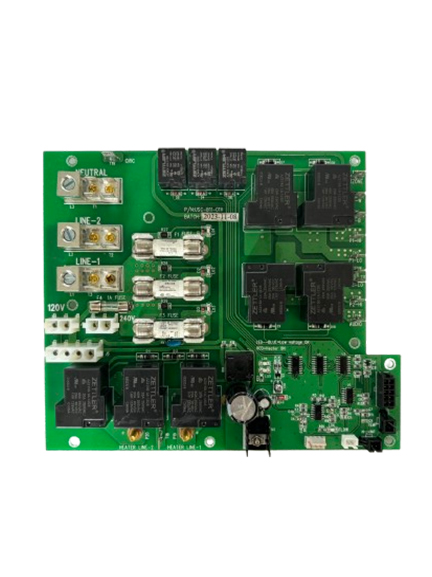
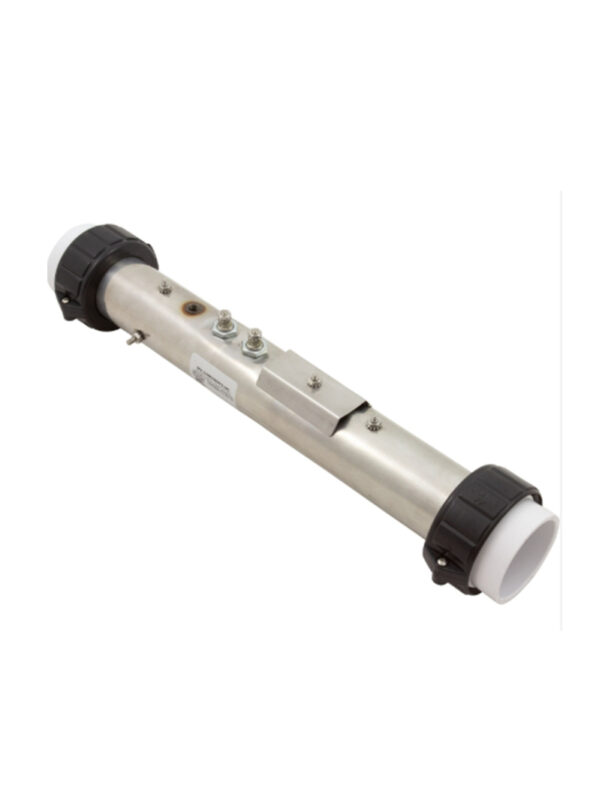
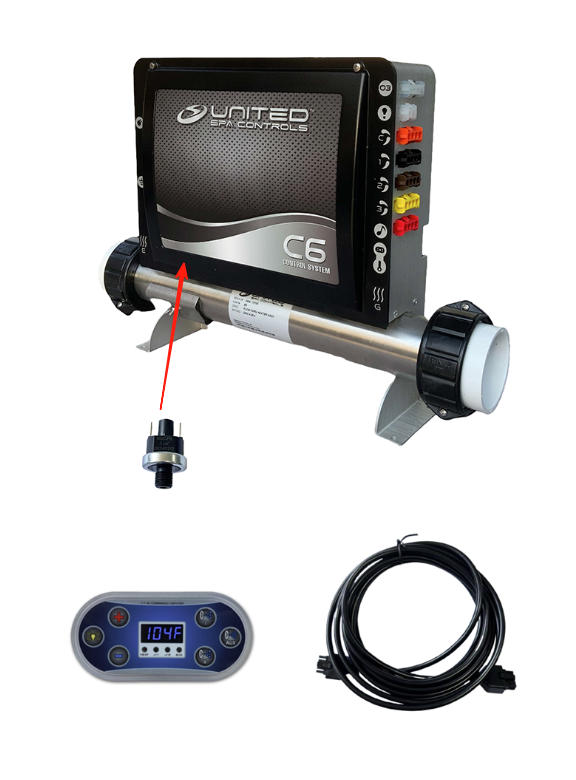
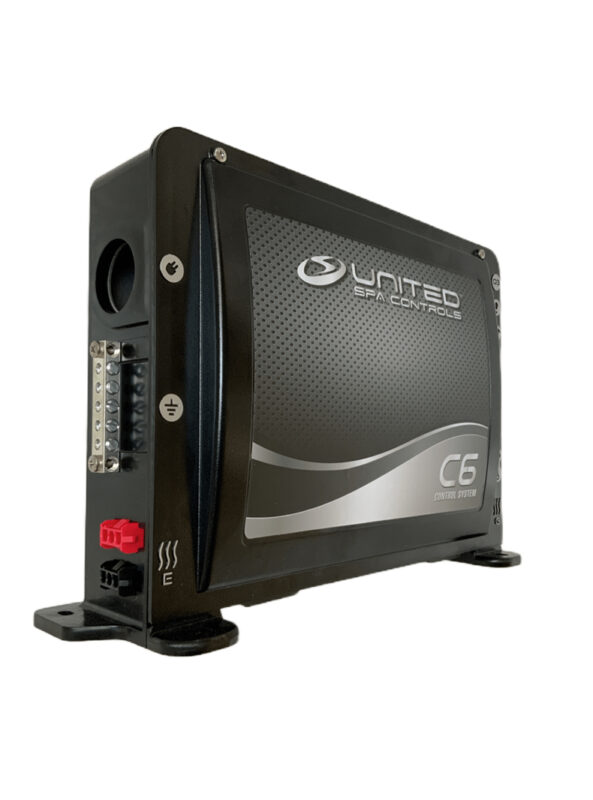
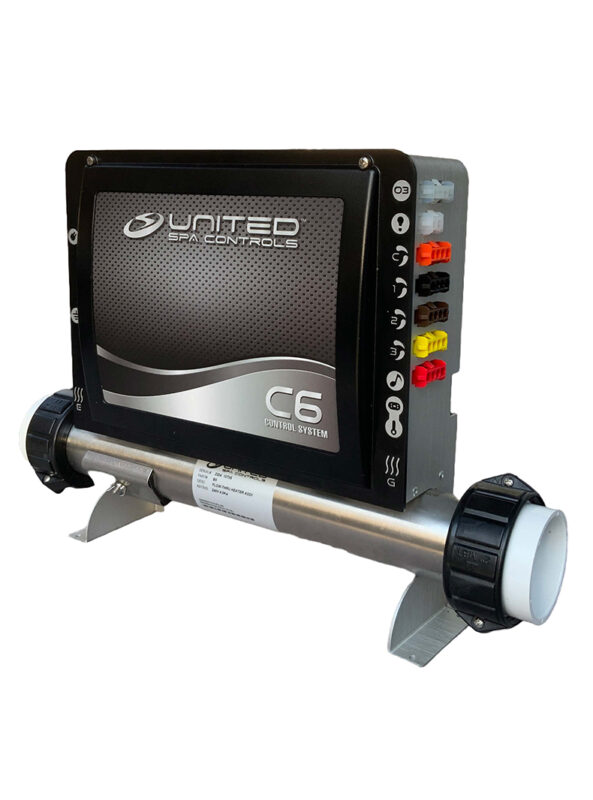
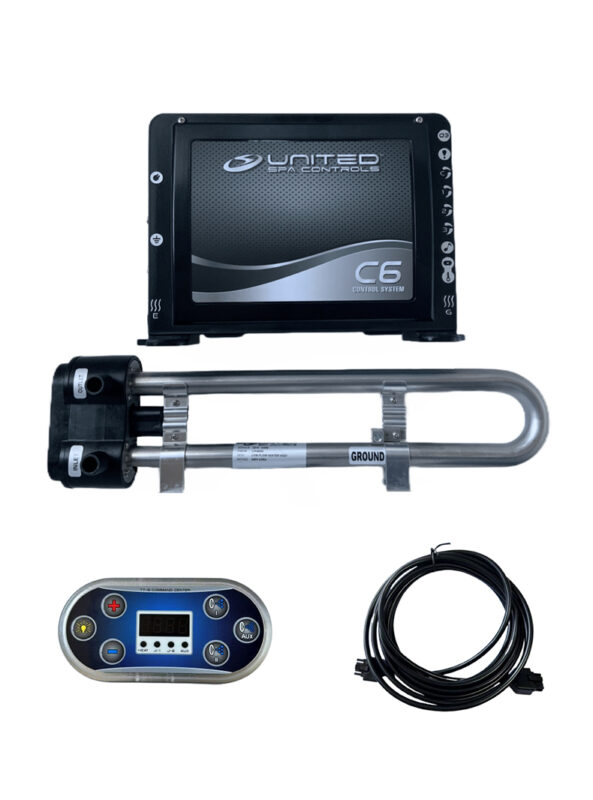
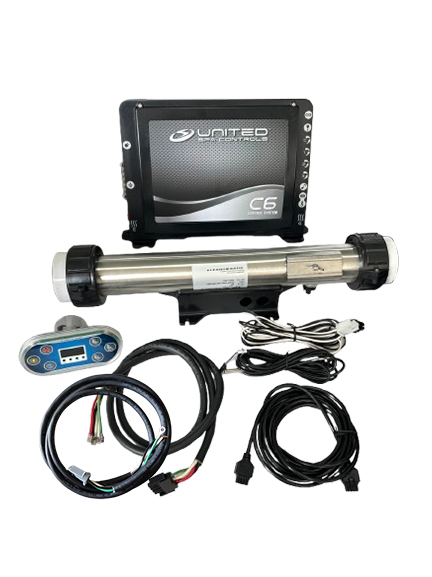
On United Spa Controls systems — the CB117P, C6, and B Box — the spa thermostat function is handled by a dedicated NTC temperature sensor probe mounted in the heater manifold. The sensor connects to the control board via a two-wire harness with a keyed plug. The board reads resistance across the sensor and converts the value to a temperature display on the topside panel (on B Box systems, there is no display, so overtemperature events are handled entirely by the high limit switch).
The United Spa Controls temperature sensor is a separate component from the high limit switch. The high limit switch is a manual-reset safety device that cuts power to the heater at approximately 118°F regardless of what the temperature sensor reads — it is a backup protection that operates independently of the sensor and control board logic. A failed temperature sensor does not disable the high limit switch, and vice versa. The table below shows the three temperature-related components and their roles.
| Component | Function | Failure Symptom |
|---|---|---|
| Temperature sensor (thermostat) | Measures water temperature; signals board to control heater relay | Incorrect temp display, overheating, no heat, SN error |
| High limit switch | Emergency cutoff at ~118°F; manual-reset; independent of sensor | Recurring HL error, no heat when cool water present |
| Pressure switch | Confirms water flow before allowing heater to energize | No heat with pump running, FLO error |
When diagnosing a spa thermostat problem on a United Spa Controls system, always check all three components in sequence. The most efficient order is: pressure switch first (rules out a flow fault), then temperature sensor (rules out a measurement fault), then high limit switch (rules out a thermal safety trip). Replacing the sensor without first ruling out a high limit switch trip or a pressure switch fault wastes time and money.
For a detailed guide specific to United Spa Controls temperature sensors, see our temperature sensor guide. For high limit switch diagnostics, see our spa high limit switch guide. For pressure switch faults, see our pressure switch guide.
Frequently Asked Questions
What is the difference between a spa thermostat and a high limit switch?
A spa thermostat (temperature sensor) measures water temperature continuously and signals the control board to run or stop the heater to maintain the set temperature. A high limit switch is a separate emergency safety device that physically cuts power to the heater at a fixed maximum temperature (typically 118°F) and must be manually reset. The two components operate independently — a failed sensor does not disable the high limit switch. See our high limit switch guide for more detail.
What does a spa thermostat sensor resistance reading of OL mean?
OL on a multimeter means “overrange” or “open circuit” — the sensor resistance is higher than the meter can measure, which in a thermistor means the internal element has broken and no longer conducts. A healthy spa thermostat sensor reads approximately 9,000–11,000 ohms at room temperature. An OL reading means the sensor has failed and must be replaced. A reading of 0 ohms indicates a short circuit, which is also a failure.
Can I bypass the spa thermostat sensor to test the heater?
You can substitute a known-good resistor of approximately 10kΩ across the sensor terminals to simulate a room-temperature reading and see if the control board allows the heater to run. This is a valid diagnostic step performed by technicians. However, do not leave the resistor in place for normal operation — without a real temperature reading, the board cannot control water temperature and the spa will overheat. The high limit switch will eventually trip, but this is not a safe operating configuration. Our CB117P guide covers board diagnostics in more detail.
My spa thermostat shows the right temperature but the heater won’t run. What else could be wrong?
If the temperature reading looks correct but the heater won’t run, the fault is likely in the pressure switch (no flow signal reaching the board) or the heater element itself (open circuit). Check the pressure switch first — if it is stuck open, the board will not energize the heater even with a valid temperature signal. Then test the heater element resistance. See our spa heater not heating guide for the full diagnostic sequence.
What temperature should a healthy spa thermostat sensor read at 104°F?
At 104°F (40°C), a healthy NTC thermistor spa sensor typically reads approximately 5,000–7,000 ohms, depending on the sensor specification. At room temperature (70°F / 21°C), the same sensor should read approximately 9,000–11,000 ohms. The key diagnostic check is that resistance should decrease noticeably as temperature increases. If the reading does not change when you warm the sensor in water, the thermistor element is dead. See our United Spa Controls temperature sensor guide for model-specific values.
Does replacing the spa thermostat sensor require draining the spa?
Usually not. The temperature sensor on most spa systems, including United Spa Controls, mounts in a dry well or a compression fitting that allows the probe to be removed without exposing the water plumbing. Power down the spa at the GFCI breaker, allow the system to cool, disconnect the sensor harness from the board, and unscrew or release the sensor from its mounting. The water line itself remains sealed. However, if your sensor uses a barbed wet-fitting installation, you will need to close the gate valves or drain the manifold section before removal. See our spa control box replacement guide for general equipment bay procedures.
Where to Buy a Replacement Spa Thermostat
If your spa thermostat sensor tests as open-circuit, short-circuit, or fails to change resistance with temperature, it requires replacement. Spasrus stocks temperature sensors compatible with United Spa Controls CB117P, C6, and B Box systems. When ordering, confirm the sensor probe length and connector type against your existing unit, as probe length affects the sensor’s position in the heater manifold and can affect temperature accuracy if mismatched.
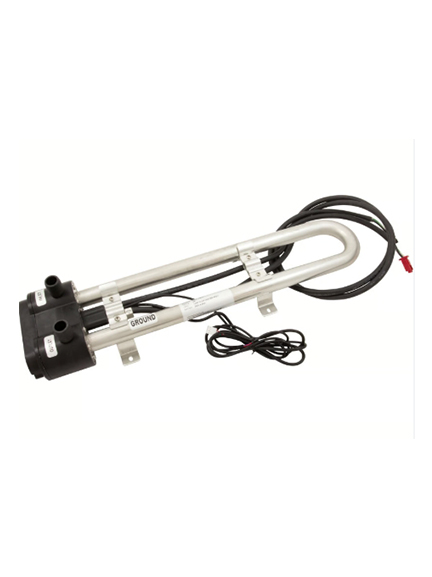
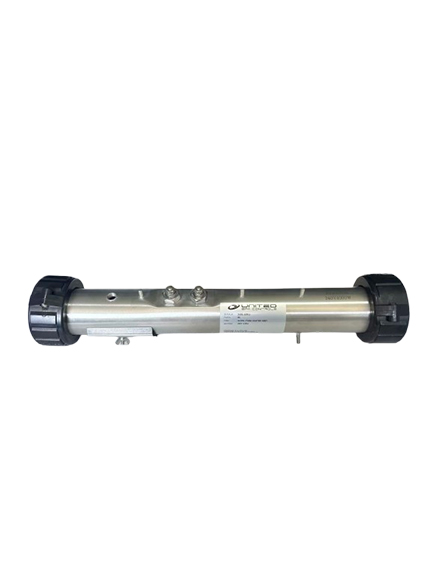
For United Spa Controls systems, replacement temperature sensors are available as a standalone part or as part of a complete heater manifold assembly. If your manifold has corrosion, scale buildup on the sensor well, or damaged threads at the sensor port, replacing the complete manifold at the same time as the sensor avoids a callback for manifold failure within weeks of the sensor replacement.
CB117P System (includes sensor) B Box System (includes sensor)
Related guides for complete temperature-control diagnosis:
- United Spa Controls temperature sensor — replacement and specs
- Spa high limit switch — HL error and thermal safety
- Spa pressure switch — FLO error and flow diagnostics
- Spa heater not heating — 7 proven fixes
- Spa heater element — testing and replacement
- Spa control system error codes guide
For the full United Spa Controls product range, see the United Spa Controls systems page and the United Spa Controls brand overview.