Spa Heater Element: 5 Critical Signs It Has Failed

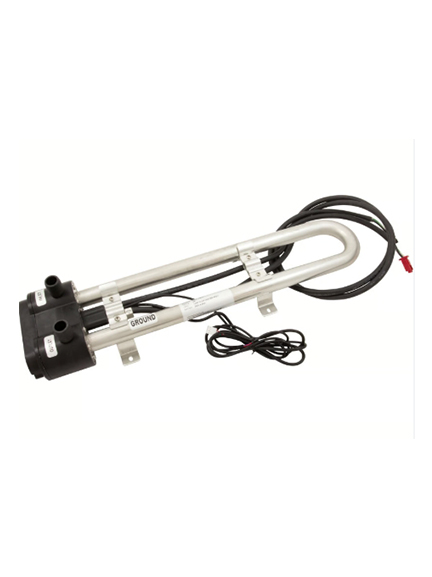
How a Spa Heater Element Works
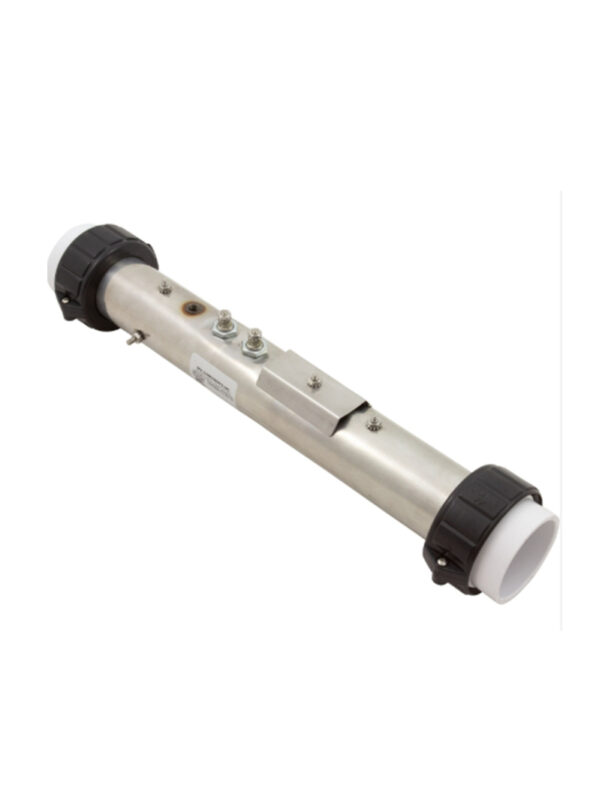
A spa heater element is a resistive heating coil encased in a stainless steel or Incoloy sheath. When 240V AC passes through the element, the coil converts electrical energy to heat. That heat transfers through the sheath and into the water flowing through the heater housing. The control box monitors water temperature via a separate sensor and switches the element on and off to maintain the set point.
The element operates only when two conditions are met: the pressure switch confirms adequate water flow, and the control board determines the water temperature is below the set point. If either condition is not met, the control board will not energize the element — even if it is functioning correctly. This is why no-heat faults require a systematic diagnosis rather than an immediate element replacement.
Inside the heater housing, the element runs through a tube that is sealed at both ends with dry end caps. The heating coil is packed in magnesium oxide powder, which insulates the coil from the outer sheath while efficiently transferring heat. As elements age, the magnesium oxide can absorb moisture, reducing the insulation resistance and eventually allowing current to leak to the sheath and ground. This insulation breakdown is the cause of most GFCI-tripping faults on the heater circuit.
The lifespan of a spa heater element depends heavily on water chemistry. Water with low pH accelerates corrosion of the sheath; high calcium hardness causes mineral scale deposits that reduce heat transfer and create hot spots on the element surface. Keeping water balanced within the recommended ranges — pH 7.4–7.6, total alkalinity 80–120 ppm, calcium hardness 150–250 ppm — significantly extends element life. The United Spa Controls brand overview covers maintenance recommendations for the full system.
5 Critical Signs Your Spa Heater Element Has Failed
Sign 1: The Spa Does Not Heat Despite Normal Pump Operation
The most obvious sign of a failed spa heater element is a spa that runs its pump normally but never reaches temperature. The water circulates, the topside panel shows the pump is active, but the temperature reading does not rise over time. This pattern tells you the heater circuit is not producing heat — which points to the element, the heater relay on the control board, or a safety lockout preventing the element from energizing.
Before condemning the spa heater element, check the control board display for error codes. A FLO error means the pressure switch is not closing; a high-limit code means the heater has been locked out due to an overheat event. If the display shows no error and the pump is running normally, the element is the next item to test. The spa heater not heating guide covers the full diagnostic sequence when the pump runs but no heat is produced.
Sign 2: The GFCI Trips Specifically When the Heater Starts
A GFCI that trips reliably at the moment the spa heater element energizes is one of the most reliable indicators of element failure. When the element’s insulation breaks down, current leaks from the heating coil to the outer sheath and then to the ground wire. The GFCI detects this ground fault current — usually above 5mA — and trips the breaker within milliseconds.
The diagnostic test is to disconnect the heater at the control box and attempt to reset and hold the GFCI. If the breaker holds with the heater disconnected but trips again when the heater is reconnected, the fault is in the heater circuit — most likely the spa heater element. If the breaker trips even with the heater disconnected, the leak is elsewhere in the system. The spa GFCI tripping guide walks through this isolation test and covers non-element causes of GFCI faults.
Sign 3: Burning or Electrical Smell Near the Equipment Compartment
A burning odor from the equipment compartment when the heater is running is a critical sign that the spa heater element is overheating. Scale buildup on the element surface creates insulating hot spots — areas where heat cannot transfer into the water, causing the element sheath to overheat locally. In severe cases, the sheath may darken, blister, or develop visible corrosion around a specific section.
A burning smell should prompt an immediate shutdown. Continuing to run a heavily scaled or overheating element risks breaching the outer sheath, which creates a direct path for leakage current. Remove the heater housing cover and visually inspect the element surface for discoloration, deposits, or physical damage. Even if the element passes a basic continuity test, visible hot spots or sheath damage warrant replacement. The S-type heater fault guide covers visual inspection criteria for the S-type element design used in United Spa Controls systems.
Sign 4: Error Codes Pointing to the Heater Circuit
Most spa control systems display error codes that indicate which component has triggered a fault. On United Spa Controls systems, a high-limit (HL) code indicates the heater circuit exceeded the safe temperature threshold — which happens when scale on the spa heater element prevents heat from dissipating into the water, or when water flow is insufficient to carry heat away from the element. A persistent HL code that resets briefly then returns strongly suggests element scaling or degraded water flow around the element.
A separate class of codes — OH (overheat) or similar — indicates the water temperature itself has exceeded the safe limit, which may or may not be element-related. Check the spa control system error codes guide for the specific code your display is showing and what it points to before starting component replacement.
Sign 5: High Resistance or Open Circuit on Multimeter Test
The definitive sign of a failed spa heater element is an abnormal reading on a multimeter. A functioning element will show a resistance reading between approximately 8Ω and 14Ω at room temperature (for a 4 kW / 240V element). An element that reads outside this range — whether too high, too low, or open circuit (OL on the display) — has failed.
An open circuit means the heating coil inside the sheath has physically broken. The element will not produce any heat, and the control board may or may not display an error depending on whether the break is detectable through the element monitoring circuit. High resistance means the element is heating less efficiently than rated and may be partially scaled or degraded. The next section covers the full multimeter test procedure for the spa heater element.
How to Test a Spa Heater Element
Testing a spa heater element requires a basic digital multimeter. The test takes less than five minutes once the heater is accessible. Before starting, follow the safety requirement: disconnect power at the circuit breaker and confirm voltage is absent at the heater terminals with a non-contact voltage tester before touching any wiring. The Electrical Safety Foundation International (ESFI) provides guidance on safe hot tub electrical work.
Step 1: Test Element Resistance at Rest
With power fully disconnected at the breaker, locate the heater terminals on the control box or heater housing. There are two element terminals (L1 and L2 on most United Spa Controls heater assemblies). Disconnect the supply wires from these terminals so the reading reflects only the element itself, not the connected circuit.
Set the multimeter to resistance (Ω) mode. Place one probe on each element terminal. For a 4 kW / 240V element, the expected resistance is:
R = V² / P = 240² / 4000 = 57600 / 4000 = 14.4Ω
In practice, readings between 10Ω and 16Ω are normal for a 4 kW spa heater element at room temperature, accounting for manufacturing tolerances and temperature variation. A reading of OL (over limit) or open circuit indicates the coil has broken internally — the element has failed. A reading significantly below 8Ω may indicate an internal short.
Step 2: Test Element Insulation to Ground
The second test checks whether the heating coil insulation is intact relative to the outer sheath (ground). This is the test that catches the insulation breakdown that causes GFCI trips.
Set the multimeter to its highest resistance range. Place one probe on an element terminal and the other probe on the outer sheath of the heater housing or the ground screw on the heater assembly. A healthy element will read OL (open) — meaning there is no measurable conduction path between the coil and the sheath. Any resistance reading below several hundred kilohms indicates insulation degradation. A reading below 50kΩ is a strong indicator that the element will cause GFCI trips under operating voltage, even if the element appears to heat the water normally.
United Spa Controls Heater Element Specs
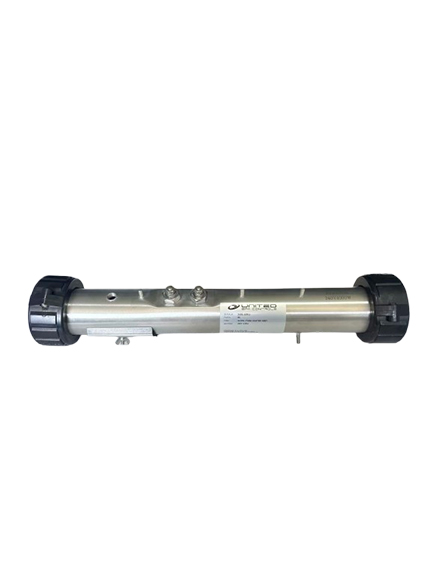
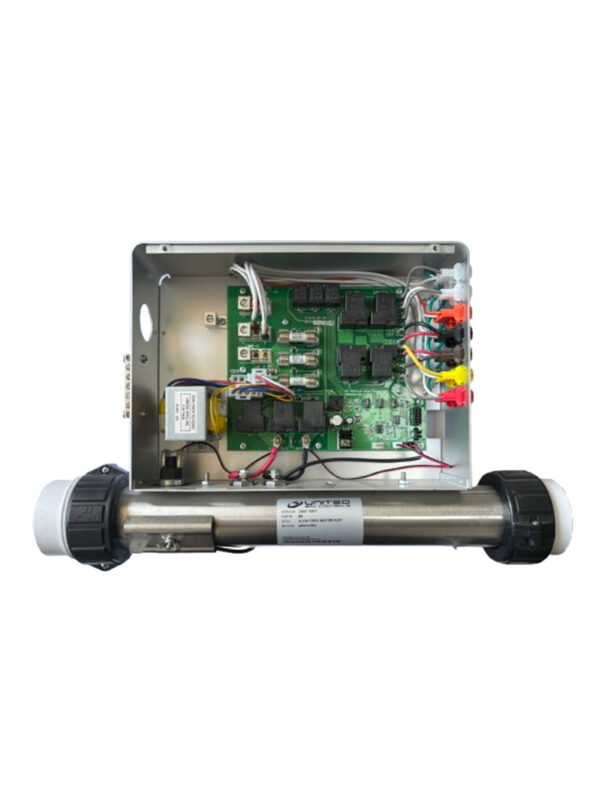
United Spa Controls heater assemblies use the S-type bottom-loading element design. The spa heater element slides up through the base of the control box and is secured by a compression fitting. This differs from the tube-style heater used in some other brands, where the element is a separate tube that mounts externally on a manifold.
| System | Heater Type | Element Rating | Voltage | Normal Resistance |
|---|---|---|---|---|
| CB117P | S-type, bottom-loading | 4 kW | 240V / 60Hz | ~14Ω |
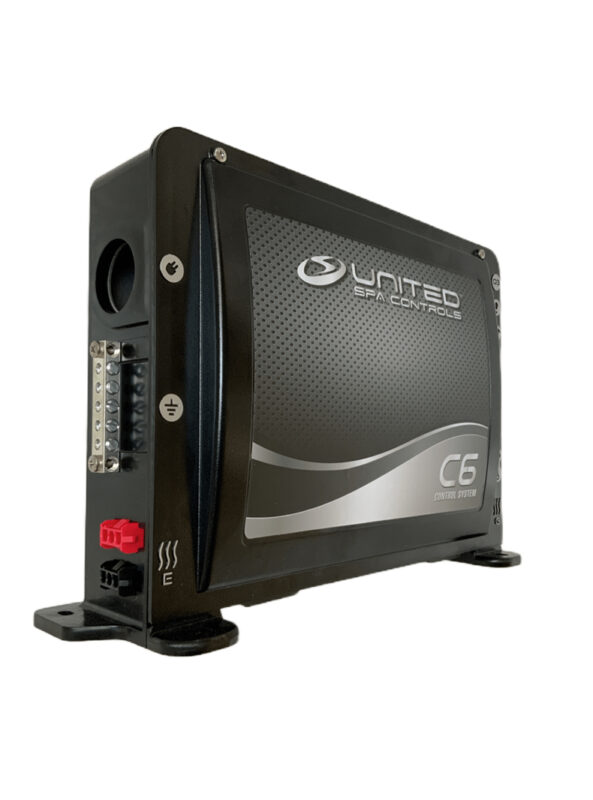
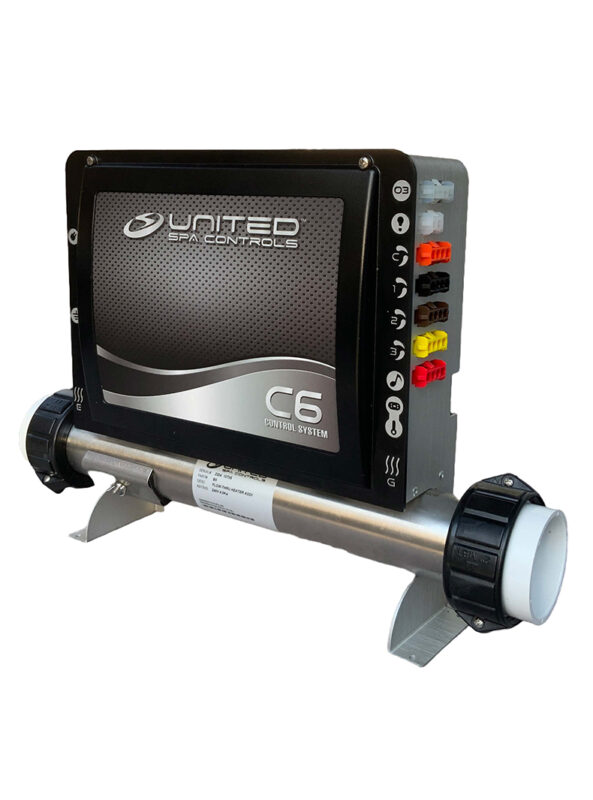
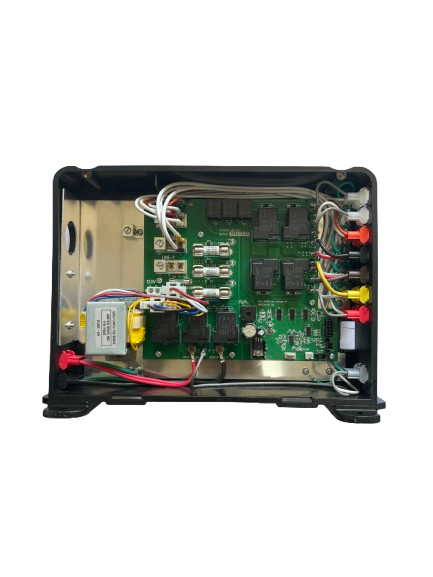
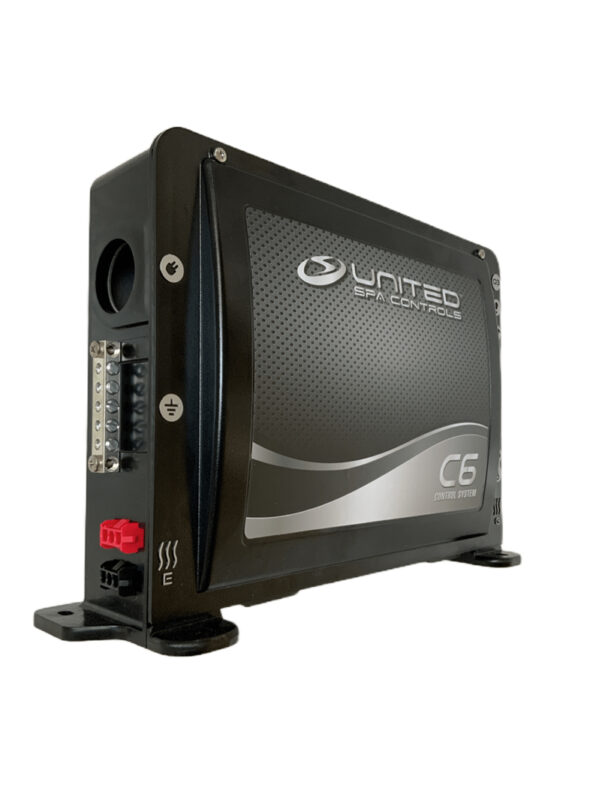
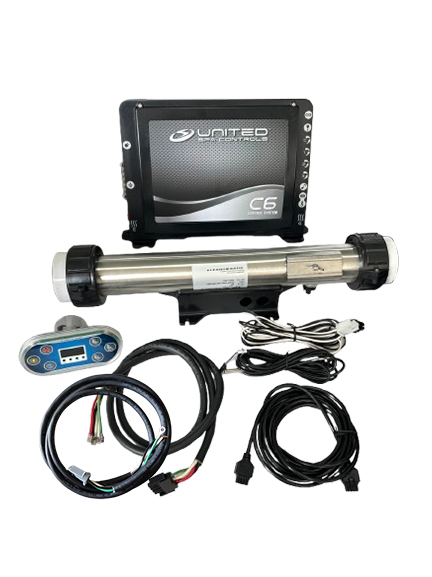
| C6 | Side-loading element | Varies by config | 240V / 60Hz | Check label |
| CR117S | S-type, bottom-loading | 4 kW | 240V / 60Hz | ~14Ω |
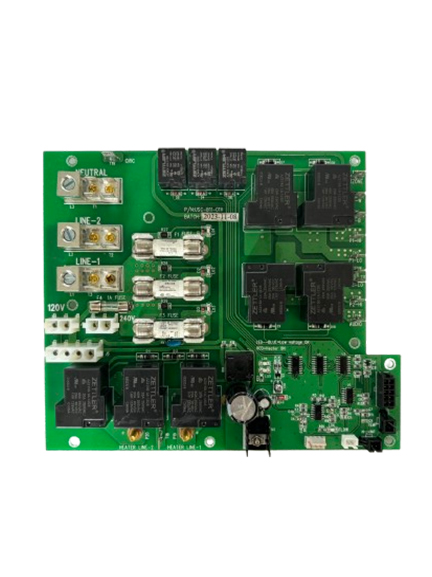
For the United Spa Controls CB117P and CR117S, the spa heater element is the S-type 4 kW unit. Replacement elements for these systems must match the S-type bottom-loading form factor — a tube-style element from a different brand will not fit the CB117P heater housing without modifications that are not recommended. When ordering a replacement element, verify the model matches: CB117P element for CB117P systems, C6 element for C6 systems.
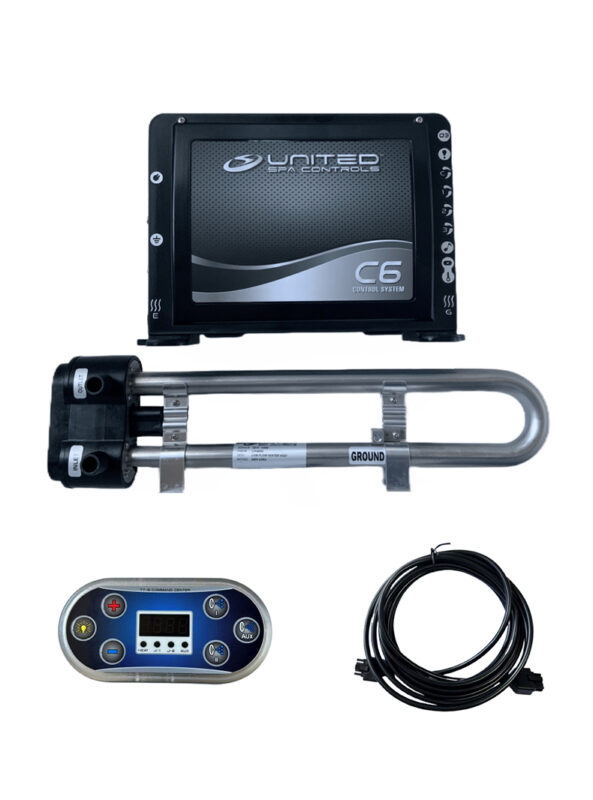
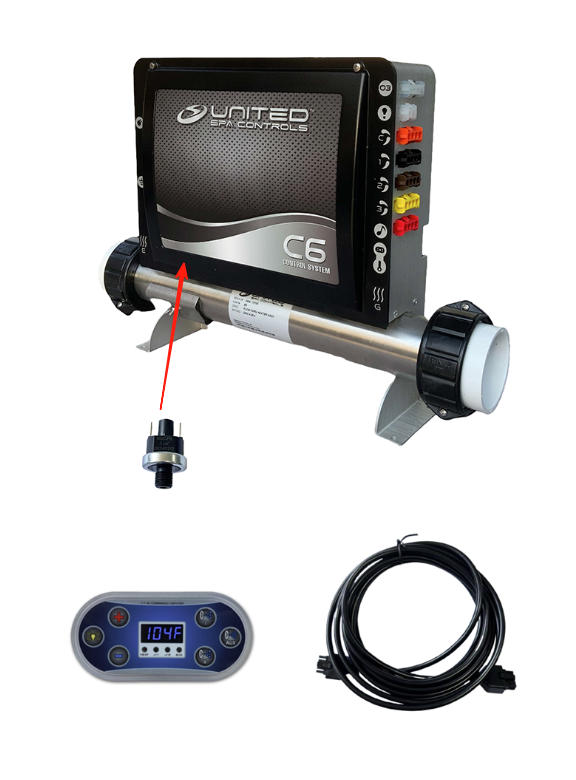
If the control board or pressure switch has also failed alongside the spa heater element, a full kit replacement (CB117P or C6 kit) is often more practical than ordering individual components. The spa control box replacement guide covers the decision framework between full kit replacement and targeted component repair. The spa pack replacement guide covers cases where multiple components have failed simultaneously.
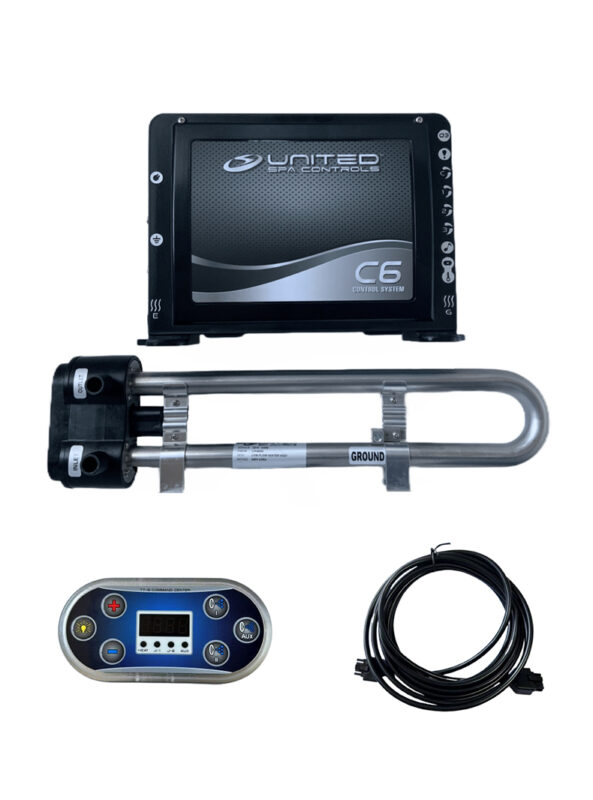
Spasrus stocks the United Spa Controls CB117P kit — control box, S-type heater, T7 topside, and pressure switch — with same-week shipping to most US zip codes. If you need just the element or the full kit, contact us to confirm the correct part for your system.
View CB117P Heater Kit on Spasrus →
Frequently Asked Questions
How long does a spa heater element last?
A spa heater element typically lasts 3 to 7 years under normal conditions. The main factors that shorten element life are imbalanced water chemistry (particularly low pH, which corrodes the Incoloy sheath), mineral scale buildup that creates hot spots on the element surface, and operating the element at low water flow for extended periods. Spas that maintain water chemistry within recommended ranges and clean filters regularly tend to see longer element life.
A spa heater element that lasts fewer than two years in a well-maintained system may indicate an underlying issue — low flow, a control board that is not cycling the element correctly, or a water chemistry problem that is not being caught by routine testing. Address the root cause before installing a replacement to avoid repeating the failure.
Can I replace just the spa heater element, or do I need to replace the whole heater assembly?
In most cases, you can replace just the spa heater element. The element is the serviceable wear component inside the heater assembly; the housing, manifold, and compression fittings are typically reused. On United Spa Controls S-type systems (CB117P, CR117S), the element slides out of the bottom of the control box housing after the compression fitting is loosened and the supply wires are disconnected.
Full heater assembly replacement is warranted when the housing itself is corroded or cracked, when the manifold shows mineral deposits that cannot be descaled, or when the compression fitting threads are damaged and will not seal correctly with a new element. In those cases, the housing and manifold should be replaced along with the spa heater element.
Why does my GFCI trip when the spa heater element starts but not during pump operation?
A GFCI that trips specifically at heater startup — not during pump-only operation — almost always indicates a ground fault in the spa heater element circuit. The heater draws significantly more current than the pump (4 kW at 240V = approximately 16.7A), so a small amount of leakage current that goes undetected at pump load becomes detectable at heater load. The GFCI is doing its job correctly: it is detecting current that is leaving the circuit through a path other than the neutral wire.
The most common cause is a spa heater element with degraded insulation — current is leaking from the heating coil to the outer sheath. Disconnect the heater leads at the control box and perform the insulation-to-ground resistance test described in the testing section above. If the reading is low, the element needs replacement. If the insulation test passes, the issue may be a wiring fault between the control box and the heater rather than the element itself.
What is the correct resistance for a spa heater element?
For a 4 kW / 240V spa heater element — the rating used in United Spa Controls CB117P and CR117S systems — the theoretical resistance is approximately 14.4Ω (calculated as V² / P = 57600 / 4000). In practice, readings between 10Ω and 16Ω at room temperature are within the acceptable range, accounting for manufacturing tolerances and the effect of temperature on resistance.
Readings outside this range indicate a problem: OL or open circuit means the coil has broken internally; significantly below 8Ω may indicate an internal short. For elements with different wattage ratings, the expected resistance will differ — always calculate the expected value using R = V² / P with the element’s rated voltage and wattage before interpreting the measurement.
Can scale buildup on the spa heater element cause a GFCI trip?
Yes, indirectly. Mineral scale on the spa heater element surface acts as an insulating layer that prevents heat from transferring into the water. The element sheath overheats in the scaled areas, which accelerates degradation of the magnesium oxide insulation inside the element. Over time, the degraded insulation allows current to leak to the outer sheath — which is the direct cause of the GFCI trip.
Scale-caused GFCI trips are more common in areas with hard water and in spas where calcium hardness levels are not regularly maintained. If the failed element shows visible white or grey mineral deposits, address the water chemistry before installing the replacement to avoid the same pattern repeating on the new element.
Is the spa heater element the same as the heating element in a hot tub pack?
Yes. Spa heater element and hot tub heating element refer to the same component — the resistive coil inside the heater assembly that converts electricity to heat. The terminology varies by manufacturer and by service context, but the underlying component is the same regardless of whether the system is called a spa pack, a hot tub control system, or a spa control box.
On United Spa Controls systems, the spa heater element is the S-type bottom-loading unit. On other brands using tube-style or flow-through heaters, the element design is different, but the function and failure modes are identical. The resistance test and insulation test described in this guide apply to all 240V spa heating elements, regardless of brand.
Where to Buy a Spa Heater Element
For United Spa Controls systems, the spa heater element is available through Spasrus either as a standalone replacement or as part of the complete CB117P kit. The full kit — which includes the control box, S-type heater, T7 topside, and pressure switch — is the more practical choice when the control board or pressure switch has also failed, or when the heater housing shows corrosion or seal damage that will require replacement regardless.
If only the spa heater element has failed and the rest of the system is in good condition, ordering the element alone is more cost-effective. Contact Spasrus to confirm the correct element SKU for your specific system before ordering — the CB117P and CR117S use the same S-type form factor, but the C6 system uses a different element that is not interchangeable. The United Spa Controls CB117P guide covers the full kit contents and what each component costs to replace individually.
For related diagnostic guides, the spa heater not heating guide covers the full no-heat diagnostic sequence, the spa GFCI tripping guide covers GFCI faults in detail, and the S-type heater fault guide covers fault codes specific to the United Spa Controls heater assembly. The spa pressure switch guide is useful when a FLO error accompanies the no-heat condition, as the two issues sometimes occur together when the heater manifold area is serviced.
For the full United Spa Controls product lineup, visit the United Spa Controls systems page or read the United Spa Controls brand overview.