S-Type Heater Fault: 5 Proven Fixes That Work

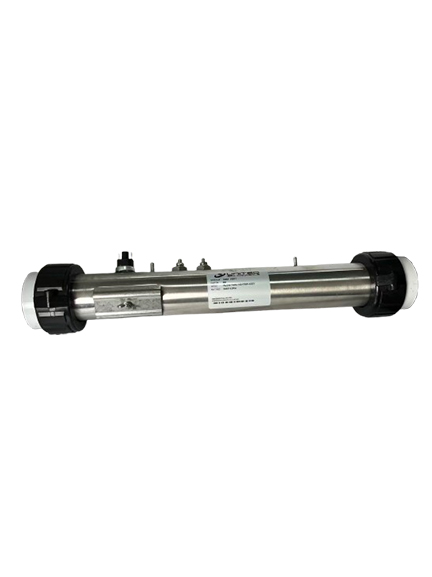
- An S-type heater fault refers to a fault on a spa heater assembly where the inlet and outlet ports are arranged in an S-curve configuration — common in older and mid-range residential hot tubs.
- The five most common S-type heater faults are: flow restriction, failed pressure switch, failed heating element, air lock, and union fitting leaks.
- Most S-type heater faults present as FLO error codes, no-heat conditions, or GFCI trips — the same symptoms as other heater types, diagnosed using the same isolation sequence.
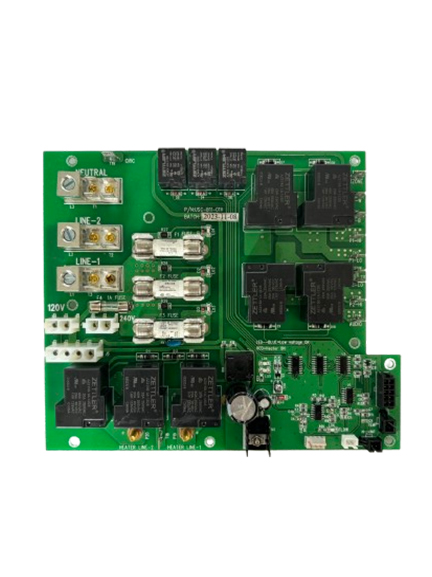
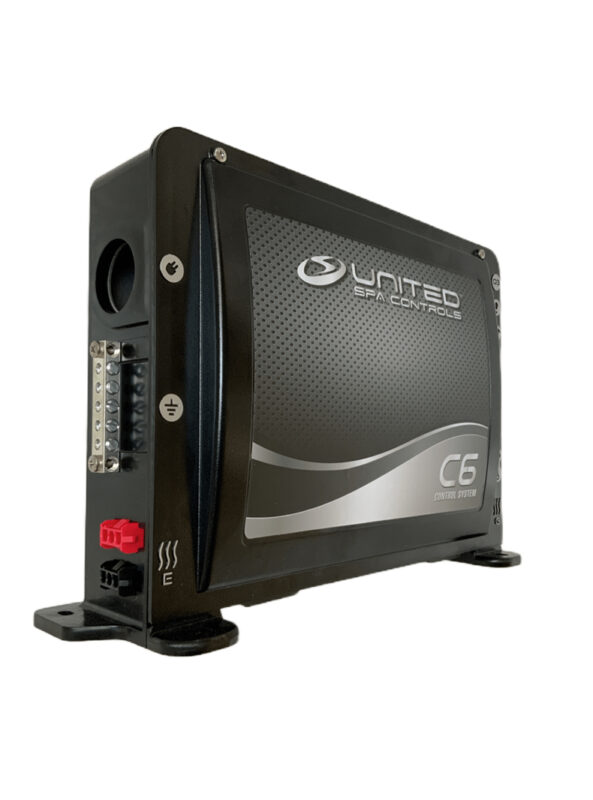
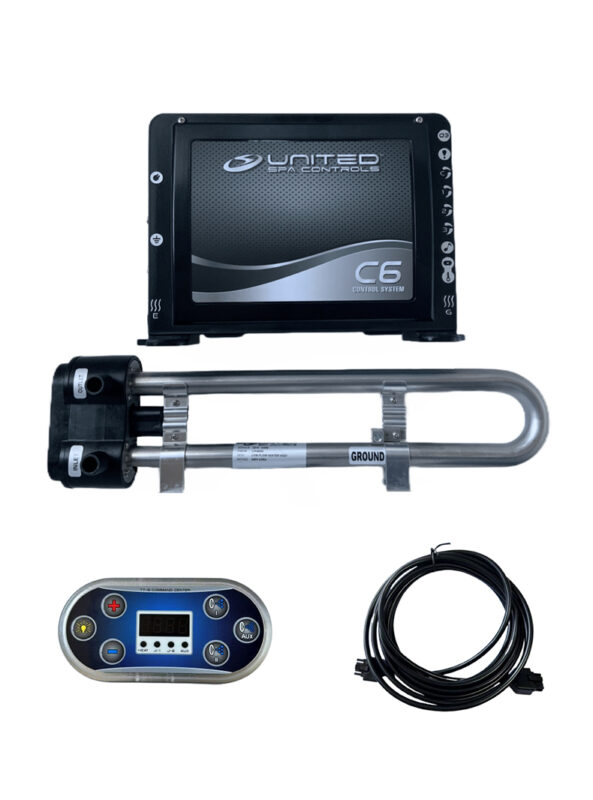
- United Spa Controls CB117P and CR117S systems can replace aging S-type heater configurations in most residential installations.
- Before replacing the heater assembly, always test the pressure switch and element separately — these are the two most common fault components.
An s-type heater fault is one of the most searched spa troubleshooting terms — and one of the most misunderstood. The “S-type” designation refers to the physical layout of the heater manifold: the water inlet and outlet ports are arranged in an S-curve pattern, routing water through the heater body in a specific flow path. This configuration is common in residential hot tubs manufactured between the 1990s and 2010s.
An S-type heater fault can manifest as several different symptoms — a FLO error code, a spa heater not heating, a GFCI trip, or a water leak at the heater unions. Understanding what type of fault has occurred is essential before ordering any replacement parts, because the heater assembly, pressure switch, and heating element are all separate components with different failure modes and different replacement costs.
This guide covers the five most common S-type heater faults, how to diagnose each one, and when the United Spa Controls system range is the right replacement path.
For a complete overview of United Spa Controls replacement systems, see the United Spa Controls Brand Overview.
What Is an S-Type Heater and How Does It Work?
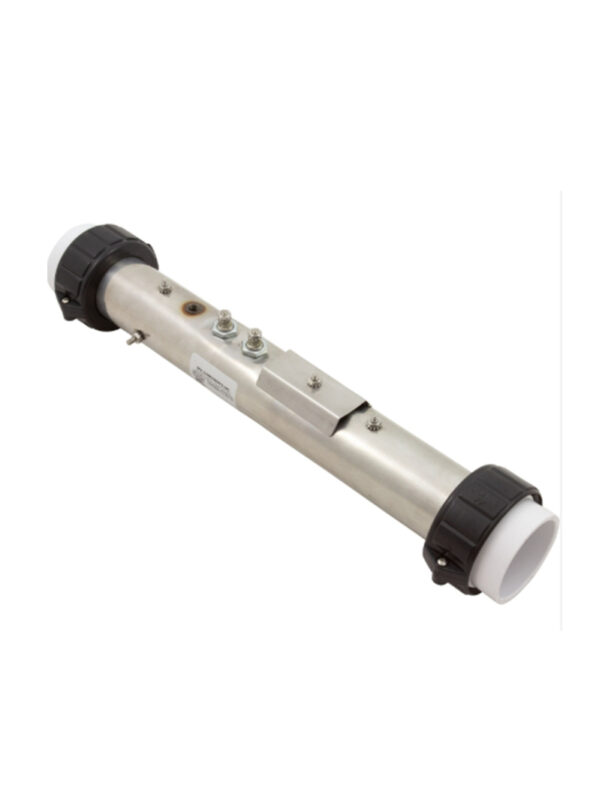
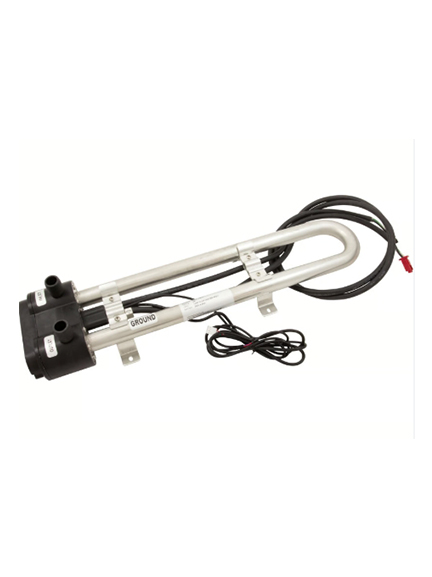
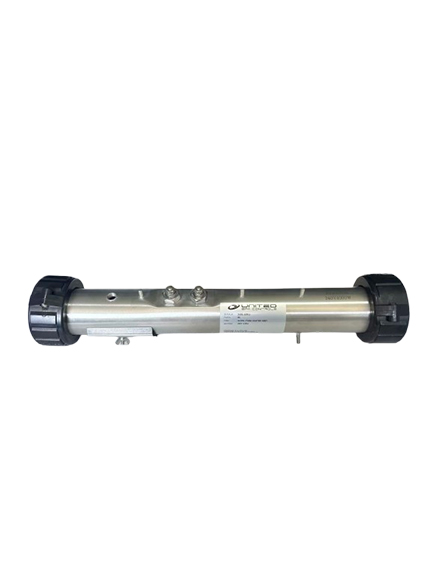
The term “S-type heater” describes the shape of the heater manifold — the stainless steel or polymer housing that contains the heating element and directs water flow through the heater circuit. In an S-type configuration, the water inlet enters from one side, flows through the heater body past the heating element, and exits from the opposite side — creating an S-shaped flow path when viewed from above.
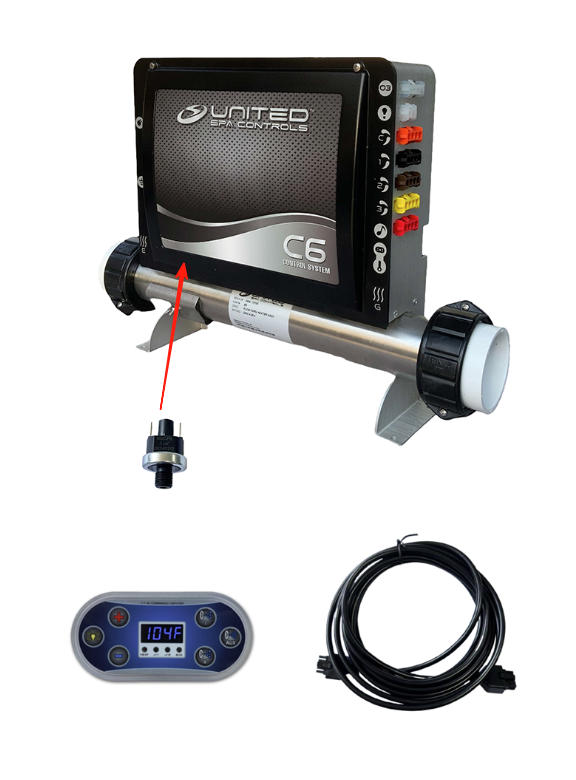
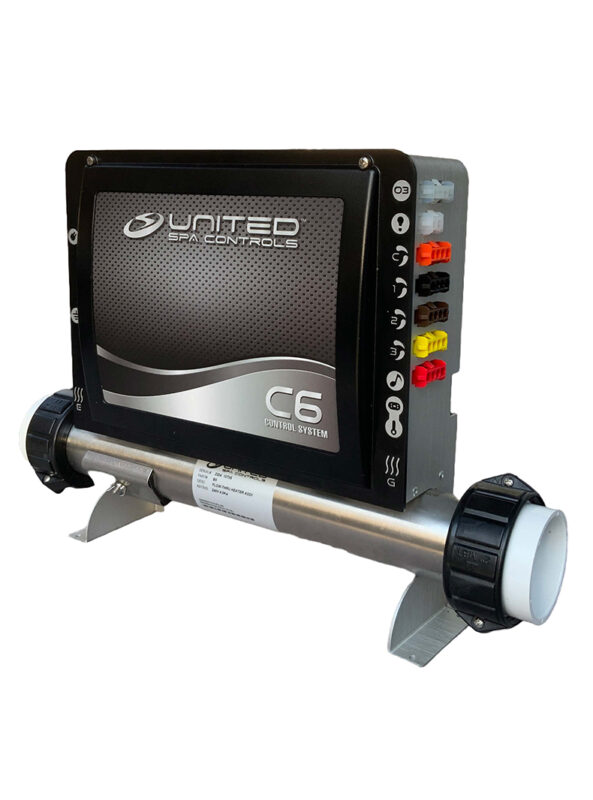
This contrasts with a straight-through heater (where inlet and outlet are on the same axis) or a bottom-mount heater like those used in the United Spa Controls CB117P, where the heater assembly is integrated into the base of the control box.
S-type heaters typically include:
- The heater manifold body — stainless steel or thermoplastic housing
- The heating element — resistance wire element sealed inside a titanium or stainless steel tube, inserted into the manifold
- A pressure switch port — tapped into the manifold to sense water flow through the heater
- A high-limit sensor port — for the thermal safety cutoff sensor
- Union fittings — on the inlet and outlet for connection to the spa plumbing
Because the S-type heater is a separate assembly from the control box, each component can be replaced independently — unlike the CB117P integrated system where the element and manifold are replaced as a unit.
5 Common S-Type Heater Faults and How to Fix Them
Fault 1: FLO Error — Flow Restriction Through the Heater
The most common S-type heater fault is a FLO, FL, or DR error code caused by inadequate water flow through the heater manifold. In an S-type configuration, water must flow through the S-curve path at sufficient pressure to close the pressure switch. Anything that reduces flow below this threshold triggers the error.
Common causes of flow restriction in an S-type heater system:
- Blocked filter — the most frequent cause. A clogged filter reduces pump output below the heater flow requirement.
- Closed or partially closed valves — a gate valve on the heater inlet or outlet inadvertently left partially closed.
- Mineral scale buildup inside the manifold — in hard water areas, calcium deposits can narrow the internal flow path over time.
- Air lock in the heater body — trapped air after a refill prevents water from filling the manifold completely.
Fix: Check the filter first — remove it and test whether the FLO error clears. If it does, clean or replace the filter. For air locks, run the jets on high for 60 seconds to purge trapped air. For mineral scale, a heater manifold flush with a citric acid descaler can restore internal flow. For a complete flow diagnosis sequence, see our guide on United Spa Controls low flow heater errors.
Fault 2: Failed Pressure Switch
The pressure switch on an S-type heater sits in a tapped port in the manifold body and monitors water pressure inside the heater. A failed pressure switch — stuck open or stuck closed — produces a persistent FLO error that does not clear even when water flow is confirmed adequate.
Pressure switch failure is one of the most common S-type heater faults because the switch is directly exposed to spa water chemistry. Chlorine, pH imbalance, and calcium deposits all accelerate switch diaphragm degradation over time.
How to test: With power disconnected, disconnect the pressure switch wires. Set a multimeter to continuity mode and probe the switch terminals. With the pump running, the switch should close (show continuity). An open reading with the pump running confirms switch failure. A brief bypass test — jumpering the switch terminals — can confirm the switch is the only fault, but remove the jumper immediately after testing. Never run the heater with the pressure switch bypassed.
Fix: Replace the pressure switch. S-type heater pressure switches are a standard thread fitting — confirm the thread size (typically 1/8″ NPT) before ordering a replacement. On United Spa Controls systems, the pressure switch is included with the complete CB117P system.
Fault 3: Failed Heating Element
The heating element inside an S-type heater manifold is a resistance wire sealed inside a protective tube. Element failure can be sudden (burned-out wire causes an open circuit and the heater stops working entirely) or gradual (insulation breakdown causes a partial ground fault, leading to GFCI trips).
Element failure is the most expensive S-type heater fault to repair because the element is typically sealed into the manifold and requires full manifold disassembly to replace — on older assemblies, the element may be corroded into the manifold body and effectively non-removable, requiring full manifold replacement.
How to test: With power disconnected at the breaker, disconnect the element leads from the control box. Measure resistance across the two element terminals — a functioning element reads 8–16 ohms. An open circuit (OL) means the element wire has burned out. Also measure from each terminal to the heater housing — any continuity to ground indicates an insulation failure and a GFCI trip hazard. For the full element testing procedure, see our Spa GFCI Tripping guide.
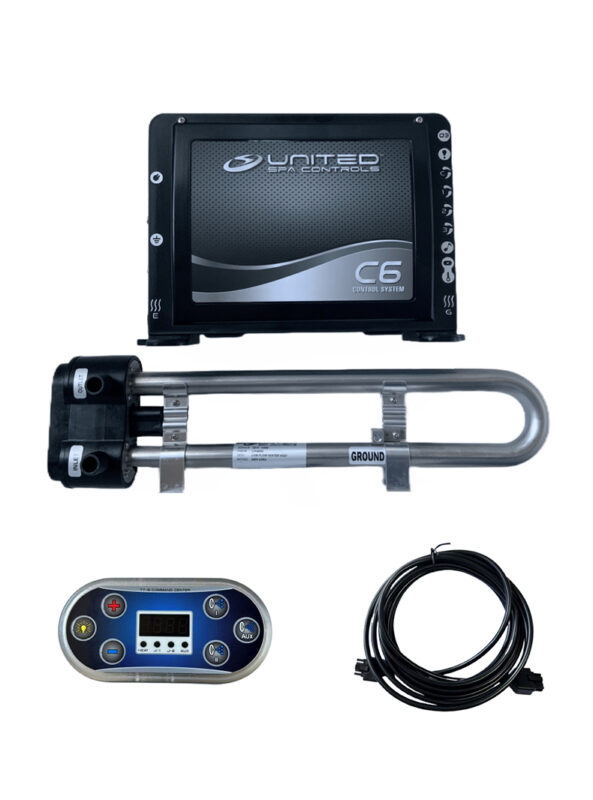
Fix: If the element is accessible and removable, replace the element only. If the element is corroded in place or the manifold shows corrosion damage, replace the full heater assembly. On systems using United Spa Controls CR117S, the remote heater assembly is replaced as a unit.
Fault 4: Air Lock After Refill or Service
Air locks are a specific S-type heater fault that occurs most often after draining and refilling the spa, after winterization, or after any plumbing work. The S-curve geometry of the heater manifold creates a natural trap where air can become caught — particularly at the top of the S-curve — preventing water from filling the heater completely.
An air lock in the S-type heater presents exactly like a flow fault: the pressure switch cannot close because air rather than water occupies the manifold sensing chamber. The FLO code appears immediately on startup after a refill, even with a clean filter and open valves.
Fix: Run the jets on maximum speed for 60–90 seconds. The increased flow velocity through the plumbing usually pushes air out of the heater manifold and the FLO error clears. If the error persists, try loosening the union fitting at the heater inlet slightly while the pump runs — this allows the trapped air to escape — then retighten immediately. On some S-type installations, bleeding air from the highest point in the heater circuit via a bleed valve or loose union fitting is the only reliable method.
Fault 5: Union Fitting Leak
Union fittings at the S-type heater inlet and outlet are a common source of water leaks. The unions allow the heater to be removed for service without cutting the plumbing, but the rubber O-rings inside the unions deteriorate over time — especially with aggressive water chemistry or UV exposure. A leaking union causes water loss, wet equipment bay conditions, and can accelerate electrical component corrosion.
How to identify: Inspect the area around the heater inlet and outlet unions for water staining, mineral deposits (white calcium scale), or active dripping. Even small leaks leave characteristic staining patterns on the heater body and surrounding plumbing.
Fix: Replace the union O-rings. Shut off power and close any isolation valves before disassembling the union. New O-rings are typically inexpensive and available at spa supply retailers. If the union body itself is cracked or the threads are damaged, replace the full union fitting. Lubricate new O-rings with a silicone-compatible O-ring lubricant before reassembly.
S-Type Heater Fault Diagnosis: Step-by-Step Sequence
Work through this sequence in order. Each step rules out a cause before moving to the next, preventing unnecessary part replacement.
Before starting: Disconnect power at the breaker. Refer to the Electrical Safety Foundation International for general electrical safety guidance before working on any spa electrical system.
Step 1: Check for error codes. If the spa displays FLO, FL, DR, or OH, treat the error code first. FLO/FL/DR points to flow or pressure switch. OH points to temperature sensor or actual overheating.
Step 2: Remove and inspect the filter. Pull the filter cartridge and run the spa without it briefly. If the error clears, the filter was the cause — clean or replace it.
Step 3: Check for air lock. If the spa was recently refilled, run jets on high for 60–90 seconds to purge any air from the heater manifold.
Step 4: Test the pressure switch. Disconnect switch wires and test continuity with the pump running. Open = switch failure. Jumper briefly to confirm, then replace the switch.
Step 5: Test the heating element. Disconnect element leads. Measure resistance across terminals (should be 8–16 ohms) and from each terminal to the heater body (should be no continuity). Open circuit or continuity to ground = element failure.
Step 6: Inspect union fittings. Check both inlet and outlet unions for leaks or O-ring deterioration. Replace O-rings if any staining or dampness is present.
S-Type Heater Fault: When to Replace vs. When to Repair
The repair vs. replace decision for an S-type heater fault depends on the age of the system, the specific component that failed, and the overall condition of the spa equipment.
| Fault | Repair | Replace Heater Assembly | Replace Full System |
|---|---|---|---|
| Flow restriction | Clean filter / flush manifold | Only if manifold is scaled beyond cleaning | If control board also failing |
| Pressure switch | Replace switch only | Not usually needed | If system is 10+ years old |
| Heating element | Replace element if accessible | If element is corroded in place | If control board also suspect |
| Air lock | Purge with high-speed jets | Not needed | Not needed |
| Union leak | Replace O-rings | If union body is cracked | Not usually needed |
If the S-type heater fault involves the heating element and the control box is also aging — more than 10 years old, showing error codes, or with a history of component failures — replacing the complete system with a United Spa Controls CB117P (bottom-mount integrated heater) or CR117S (remote heater) is often more cost-effective than replacing the S-type heater assembly alone.
For guidance on whether your system needs a component repair or a full replacement, see our Spa Control Box Replacement guide.
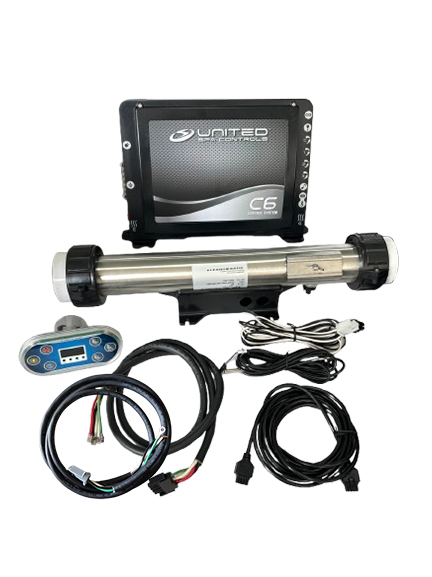
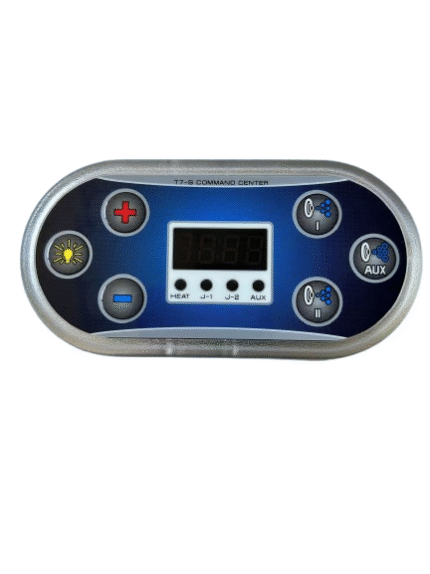
SpasRus stocks complete United Spa Controls CB117P and CR117S systems — including pressure switch, heater assembly, control board, and T7S topside panel — for worldwide dispatch.
Browse United Spa Controls Systems → Ask Us About Your Heater Type
Frequently Asked Questions: S-Type Heater Fault
What does s-type heater fault mean on my spa display?
An S-type heater fault error on a spa display typically refers to a fault condition detected in the S-type heater assembly — most commonly a FLO or flow-related error. The S-type designation describes the shape of the heater manifold, not a specific error code. The actual error code (FLO, FL, DR, OH) tells you what kind of fault has occurred. FLO means the flow switch is not detecting adequate water flow. OH means the temperature has exceeded the safety limit. Work through the diagnosis steps in this guide to identify which specific component has failed.
Can I replace an S-type heater with a United Spa Controls system?
Yes, in most cases. If the existing spa uses an S-type heater with a separate control box, the complete system can be replaced with a United Spa Controls CR117S — which uses a remote heater assembly that can be plumbed into the existing heater location. Alternatively, if the plumbing can be adapted, the CB117P with its integrated bottom-mount heater may also be suitable. The key compatibility checks are the plumbing connection sizes (typically 2-inch), the pump configuration, and the voltage supply. Contact SpasRus to confirm compatibility before ordering.
My S-type heater is leaking from the unions. Do I need a new heater?
Not necessarily. Union leaks are usually caused by deteriorated O-rings inside the union fittings — the O-rings cost very little and can be replaced without removing the heater assembly. Shut off power, close any isolation valves, unscrew the union collar, pull the fitting apart, and replace the O-ring. If the union body itself is cracked or the threads are stripped, the union needs replacing — but the heater manifold itself may still be fine. Only replace the heater assembly if the manifold body is damaged, corroded through, or if the heating element inside has failed.
How do I know if my S-type heater element has failed or just the pressure switch?
The failure pattern usually tells you which one. A failed pressure switch causes a FLO error that does not clear even with confirmed good flow — but the heater element is electrically fine (correct resistance, no GFCI trips). A failed heating element causes either no-heat despite the heater being called for (open circuit element) or GFCI trips when the heater activates (shorted element). Test the pressure switch first by checking continuity with the pump running — if it does not close, replace the switch. If the switch tests good but the heater still does not heat or trips GFCI, then test the element resistance.
Why does my S-type heater fault only appear in cold weather?
S-type heater faults that appear specifically in cold weather are usually caused by one of two things. First, a pressure switch that is borderline — it closes under normal conditions but becomes sluggish in cold temperatures when the diaphragm stiffens. Second, water viscosity increases in cold water, slightly reducing pump flow rate — if the system is already marginal on flow, cold water can push it below the pressure switch threshold. Check and service the filter first, then test the pressure switch. A switch that only fails in cold conditions is still a failing switch and should be replaced proactively.
How long does an S-type spa heater last?
A well-maintained S-type spa heater with good water chemistry typically lasts 5–10 years before the heating element needs replacement. The manifold body itself can last much longer — 15–20 years is not uncommon for stainless steel manifolds in good water conditions. Factors that shorten heater life include low pH (acidic water corrodes the element faster), high calcium hardness (scale buildup on the element surface increases surface temperature and accelerates insulation breakdown), and running the heater dry due to flow faults. Regular water chemistry maintenance is the single most effective way to extend S-type heater life.
S-Type Heater Fault Parts and Replacements
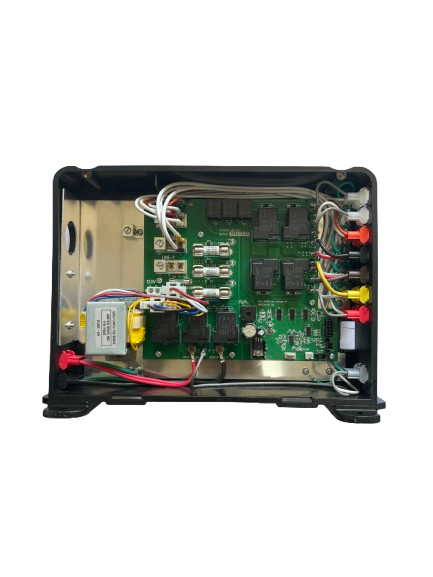
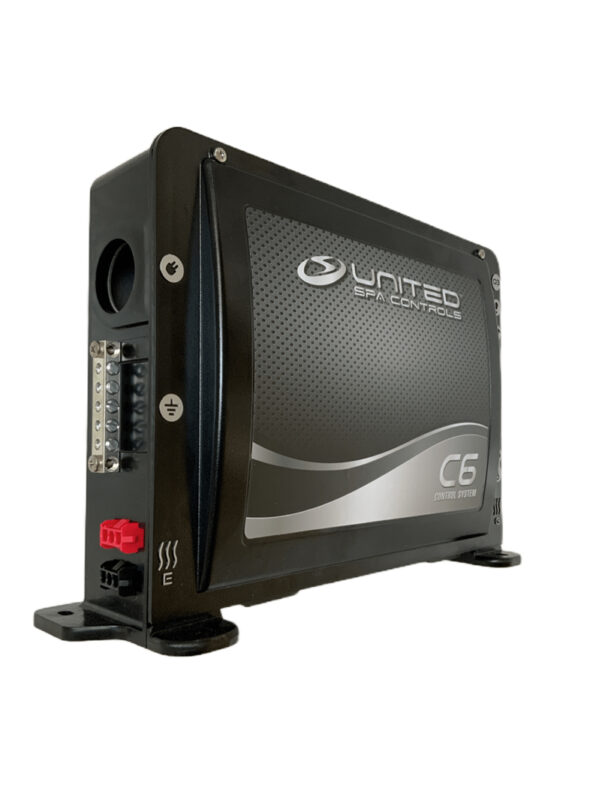
SpasRus stocks United Spa Controls complete systems as the primary replacement path for aging S-type heater installations. The C6 and CR117S are the standard replacement choices for remote or externally plumbed heater configurations.
If you are unsure whether your S-type heater fault requires a component repair or a full system replacement, contact SpasRus with your existing system details — we can help confirm the right path before you order.
Browse all United Spa Controls systems and parts at SpasRus.
For a complete overview of the United Spa Controls range, see the United Spa Controls Brand Overview.
SpasRus is a North American retailer specializing in United Spa Controls spa systems, heaters, topside panels, sensors, and compatible replacement parts for residential and light commercial hot tubs.