
Spa Pump Not Working: 6 Proven Fixes That Work

- A spa pump not working typically means one of six things: air lock, failed start capacitor, thermal overload trip, control board relay failure, wiring fault, or a seized pump motor.
- Most spa pump failures can be diagnosed with a multimeter and a visual inspection — no special tools required.
- Air lock and thermal overload trips are the two most common causes and both can be resolved without any parts replacement.
- A failed capacitor is the most common component-level pump failure and is inexpensive to replace if the motor itself is still good.
- If the pump failure is linked to a failing control box, a United Spa Controls CB117P or CR117S replacement system resolves both issues in a single installation.
A spa pump not working is one of the most disruptive faults a hot tub can develop — without the pump running, there is no jet action, no water circulation through the heater, and no filtration. The spa goes cold and stagnant until the pump is back online.
The good news is that the majority of spa pump not working cases are not caused by a burned-out motor. Air locks, thermal overload trips, and failed capacitors account for most spa pump not working calls — and all three are either free to resolve or inexpensive to fix. A full pump motor replacement is necessary far less often than most spa owners expect when they first see a spa pump not working.
This guide walks through the six most common causes of a spa pump not working, how to diagnose each one, and when the right solution is a United Spa Controls system replacement rather than pump repair.
For the full United Spa Controls system overview, see the United Spa Controls Brand Overview.
How a Spa Pump Works
Understanding why a spa pump not working occurs starts with knowing how the pump operates. A spa pump is an induction motor connected to a wet-end impeller assembly. The motor receives power from the control box via a relay — when you press the jet button on the topside panel, the control box closes the pump relay, supplying 240V (or 120V on smaller systems) to the pump motor terminals.
Most residential hot tubs use one of two pump configurations:
- Single-speed pump — motor runs at full speed when activated. Simpler and more reliable, but uses more energy than a two-speed pump during filtration cycles.
- Two-speed pump — has a low-speed winding for filtration and heating, and a high-speed winding for jet operation. Both speeds are controlled by separate relay outputs on the control box.
The pump also drives water through the heater manifold. When you have a spa pump not working situation, the pressure switch in the heater circuit cannot close — which is why a spa pump not working fault often produces a FLO error code on the topside panel at the same time. If your spa is showing a FLO error alongside the pump not running, see our United Spa Controls low flow heater guide for the full FLO diagnosis flow.
6 Proven Fixes for a Spa Pump Not Working
Fix 1: Clear an Air Lock
An air lock is the first thing to check when a spa pump not working occurs after a refill, winterization, or any plumbing work. Air trapped in the pump housing or suction lines prevents the impeller from moving water — the motor may hum briefly and then stop, or may not start at all if the thermal protection trips from running dry.
How to identify: The spa pump not working occurs immediately after a drain and refill. You may hear a brief hum or rattling sound when the pump tries to start but cannot move water.
Fix: Open the air bleed valve on the pump (most pumps have one) or slightly loosen the union fitting on the pump inlet while the pump is briefly energized. The sound of air escaping followed by water flow confirms the air lock is clearing. Once water is flowing continuously, retighten the bleed valve or union. Run the jets on high for 60 seconds to fully purge any remaining air.
Fix 2: Reset a Thermal Overload
A thermal overload trip is another common spa pump not working cause. Every spa pump motor has a thermal overload protector — a bimetal switch that trips when the motor overheats, disconnecting the motor windings to prevent burnout. A tripped thermal overload makes the spa pump not working completely: the control box relay activates, voltage is present at the pump terminals, but the motor does not run.
How to identify: The spa pump not working occurred during operation (not on initial startup). The motor housing may be hot to the touch. There is no humming or clicking from the pump when energized.
Fix: Allow the motor to cool completely — typically 15–30 minutes. The thermal overload resets automatically on most pump models once the motor cools below the reset threshold. Restore power and test. If the pump runs normally after cooling but the overload trips again within a short operating period, the motor has an underlying problem causing it to overheat — worn bearings, restricted impeller, or insulation breakdown. These require motor inspection or replacement.
Causes of thermal overload trips: blocked impeller (debris in the pump), low water level causing the pump to cavitate, a seized bearing, or operating the pump with an air lock.
Fix 3: Replace the Start Capacitor
A failed start capacitor is a common spa pump not working cause that is frequently confused with motor failure. The start capacitor is mounted on the pump motor body and provides extra starting torque. A failed capacitor causes a very specific spa pump not working symptom: the motor hums loudly when energized but does not spin. You may hear one loud hum followed by silence as the thermal overload trips to protect the stalled motor.
How to identify: Loud sustained hum from the pump motor when power is applied, followed by the motor going silent (thermal overload trip). The motor does not rotate at all — if you can briefly spin the impeller shaft by hand while power is applied (use caution — disconnect power first, then restore briefly while a partner spins the shaft), the motor may start. This confirms capacitor failure rather than a seized motor.
Fix: Disconnect power at the breaker before touching any pump components. Match the capacitor by its microfarad (µF) and voltage rating — these are printed on the capacitor body. Order a replacement capacitor and swap it out. Discharge the old capacitor before handling by shorting its terminals through a resistor or insulated screwdriver. Capacitor replacement is one of the most cost-effective spa pump repairs.
Always disconnect power before working on pump electrical components. Refer to the Electrical Safety Foundation International for guidance on safely working around spa electrical systems.
Fix 4: Check the Control Box Relay
A failed control box relay produces a spa pump not working symptom where the topside panel accepts the jet command, but no power reaches the pump motor terminals. This is a common spa pump not working scenario on aging control boxes.
How to identify: Use a multimeter to check for voltage at the pump motor terminals when the jets are commanded on. If 240V is present at the pump terminals and the pump still does not run, the fault is in the pump (see fixes 1–3 above). If 0V is present at the pump terminals when jets are commanded on, the relay is not closing — the fault is in the control box relay or the circuit board driving it.
Fix: A failed pump relay on an aging control box often means the board needs replacement. If the control box is 10+ years old or has a history of multiple component failures, replacing the full system with a United Spa Controls CB117P is typically more cost-effective than repairing the original board. See our Spa Control Box Replacement guide for the full decision framework.
Fix 5: Inspect the Pump Wiring
Loose, corroded, or damaged wiring between the control box and the pump motor is another spa pump not working cause that is easy to overlook. Wiring faults are more common in spas with older equipment bays where wire insulation has degraded, or in climates with temperature extremes that stress wire connections.
How to identify: The pump works intermittently — runs on some days but not others, or runs briefly and then cuts out. Visual inspection may reveal burned insulation at terminal connections, green corrosion on wire ends, or physically loose spade connectors at the pump motor.
Fix: Disconnect power at the breaker before inspecting any wiring. Check all pump motor terminal connections — they should be firm, clean, and properly seated. Corroded spade connectors can be cleaned with a wire brush or replaced entirely. Inspect the wire run from the control box to the pump for any signs of chafing, crushing, or insulation damage. Repair or replace damaged sections. Confirm all wiring connections match the pump’s wiring diagram before restoring power.
Fix 6: Test for a Seized Pump Motor
A seized pump motor is the most serious spa pump not working scenario — where the bearings have failed and the motor shaft can no longer rotate. Unlike a capacitor failure (where the shaft is free but the motor cannot start), a seized motor has a locked shaft. Full motor replacement or pump assembly replacement is the only fix.
How to identify: Disconnect power and attempt to rotate the pump impeller shaft by hand (accessible at the back of the motor or through the wet end). A free shaft that turns easily indicates the motor is not seized — look at capacitor or wiring faults instead. A shaft that cannot be turned, or that turns only with extreme force and grinding sensation, indicates seized bearings.
Fix: Replace the pump motor or full pump assembly. When replacing a pump on a spa with a failing control box, consider replacing the complete system with a United Spa Controls CR117S or CB117P — a complete system replacement eliminates the risk of the control box failing shortly after the pump is repaired.
Step-by-Step Diagnosis Sequence
Work through this sequence in order. Each step rules out a cause before moving to the next.
Step 1 — Check for error codes. A FLO error alongside a spa pump not working points to flow/pressure issues (possibly air lock). An OH or HH error means overtemperature — the system may have shut down the pump as a safety measure. See the Spa Control System Error Codes guide for error code definitions.
Step 2 — Check for air lock. If the pump failure occurred after a refill or service, attempt to bleed air from the pump and plumbing before any electrical diagnosis.
Step 3 — Allow thermal overload to reset. If the motor feels hot, allow 20–30 minutes to cool, then retest.
Step 4 — Check voltage at pump terminals. With power on and jets commanded, measure voltage at the pump motor terminal block. 240V present = relay is working, fault is in the pump. 0V = relay or board fault.
Step 5 — Check for capacitor failure. If voltage is present but motor hums without spinning, test or replace the start capacitor.
Step 6 — Inspect wiring. Check all connections at the pump terminal block and control box relay output for corrosion or damage.
Step 7 — Test for seized motor. If all electrical checks pass, attempt to rotate the shaft by hand to rule out mechanical seizure.
Repair vs. Replace: When to Upgrade the Full System
When dealing with a spa pump not working situation, repair is the right call when the fault is a single component — a capacitor, a wiring connection, or a thermal overload reset — and the rest of the spa system (control box, heater, sensors) is functioning correctly. In these spa pump not working cases, a targeted repair costs a fraction of a full system replacement.
Full system replacement becomes the right call when:
- The control box relay has failed and the board is aging (10+ years)
- The pump motor is seized and the control box also has active fault codes
- The spa has had multiple component failures across pumps, heater, and sensors over the past year
- Replacement parts for the original pump model are difficult to source
| Fault | Repair Cost | Recommendation |
|---|---|---|
| Air lock | Free | Repair (bleed air) |
| Thermal overload trip | Free (reset) or low (impeller cleaning) | Repair |
| Failed capacitor | Low ($10–$30) | Repair |
| Control box relay failure | Medium–High | Replace system if box is aging |
| Wiring fault | Low (parts + labor) | Repair |
| Seized motor | High (pump replacement) | Repair pump; replace system if control box also failing |
United Spa Controls C6, CB117P, and CR117S are complete control system replacements that resolve control box relay faults alongside heater and sensor issues in a single installation.
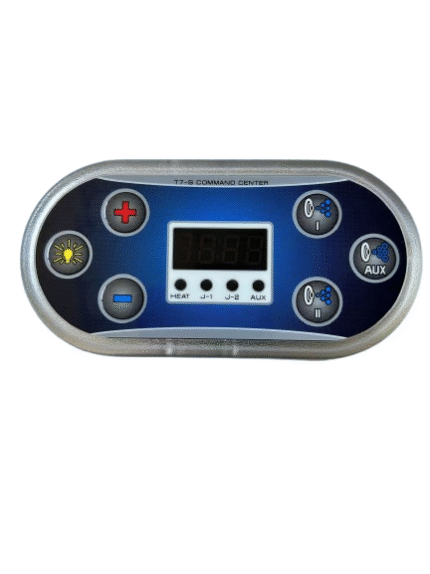
SpasRus stocks complete United Spa Controls CB117P and CR117S systems — control box, heater, T7S panel, pressure switch, and sensor — for worldwide dispatch.
Browse United Spa Controls Systems → Ask About Your Pump Issue
Frequently Asked Questions: Spa Pump Not Working
Why is my spa pump humming but not turning?
A spa pump that hums but does not spin has either a failed start capacitor or a seized motor bearing. The capacitor provides the starting torque to get the motor turning from rest — when it fails, the motor receives power but cannot overcome the initial inertia to start rotating. Test by briefly spinning the impeller shaft by hand while power is applied (use extreme caution, or have a helper do this while you restore power briefly from a safe position) — if the motor starts and runs when assisted, the capacitor has failed. If the shaft cannot be turned by hand, the motor bearings are seized and the motor needs replacement.
My spa pump worked yesterday but won’t start today. What happened?
Intermittent pump failure — working one day but not the next — is most commonly caused by a thermal overload that trips during operation and resets when cool, a failing capacitor that works when warm but not from cold, a borderline relay contact that sometimes closes and sometimes does not, or a loose wiring connection that loses contact under vibration. Start by allowing the motor to cool for 20–30 minutes and retesting. If it starts after cooling, the thermal overload is tripping during operation — find the cause (blocked impeller, cavitation, failing motor insulation). If it does not start even when cool, test the capacitor and relay voltage.
Can a spa pump failure cause a FLO error?
Yes. The FLO error (or FL, DR on some systems) is triggered when the pressure switch in the heater circuit does not detect adequate water flow. The pump drives water through the heater — if the pump is not running, there is no flow, the pressure switch stays open, and the heater shows a FLO error. When diagnosing a FLO error, always check whether the pump is actually running before assuming the pressure switch or heater has failed. If the pump is confirmed not running, fix the pump fault first — the FLO error will clear automatically once water flow is restored.
How long does a spa pump last?
A well-maintained spa pump in a clean equipment bay typically lasts 5–10 years. Factors that shorten pump life include running the pump dry (air lock conditions), aggressive water chemistry that corrodes the wet-end seals and allows water to enter the motor, debris in the impeller causing bearing wear, and thermal cycling from poor equipment bay ventilation. The wet-end seal between the motor and the water-side impeller is the most common wear component — a leaking seal allows water to enter the motor bearings and accelerates motor failure. Annual inspection of the seal and bearing condition helps catch problems before pump failure occurs.
Should I replace just the pump or the whole control system?
Replace just the pump when the control box, heater, and sensors are all functioning correctly and the pump is the only failed component. Replace the full control system when the control box relay has failed (voltage is not reaching the pump), when multiple components have failed in a short period, or when the original system is 10+ years old with a history of repairs. A United Spa Controls CB117P or CR117S complete system replacement resolves control box relay, heater, and sensor issues alongside the pump control circuit in a single installation — avoiding the risk of the next component failing shortly after the pump repair.
My spa pump runs but the jets have no pressure. Is the pump broken?
Not necessarily. Low jet pressure with the pump running is usually caused by a blocked filter (the most common cause — remove the filter and test), an air lock in the jet plumbing (partially blocked by air), closed or partially closed diverter valves, or a worn pump impeller. A blocked impeller — where debris has reduced impeller clearance — causes the pump to run but deliver significantly reduced flow. Inspect the filter first, then check all valve positions. If the filter is clean and valves are open but pressure remains low, remove the pump wet end and inspect the impeller for debris or wear.
Parts and Systems for Spa Pump Problems
For spa pump faults linked to control box relay failure, SpasRus stocks complete United Spa Controls systems — C6, CB117P, and CR117S — for worldwide dispatch. All systems include the T7S topside panel, pressure switch, and temperature sensor.
For heater-related faults discovered during pump diagnosis, see our Spa Heater Not Heating guide and the Spa GFCI Tripping guide.
Browse all United Spa Controls systems at SpasRus.
For the complete United Spa Controls range overview, see the United Spa Controls Brand Overview.
SpasRus is a North American retailer specializing in United Spa Controls spa systems, control boxes, pumps, heaters, sensors, and compatible replacement parts for residential and light commercial hot tubs.